General Product Safety Regulation: Complete GPSR Guide
Updated: 4-Oct-2026
26
The General Product Safety Regulation is an important European Union product safety law designed to ensure that consumer products placed on the EU market are safe. Officially known as Regulation (EU) 2023/988, the regulation modernized the EU’s general product safety framework and replaced the earlier General Product Safety Directive 2001/95/EC. It applies from 13 December 2024 and covers products sold through both traditional and online channels.
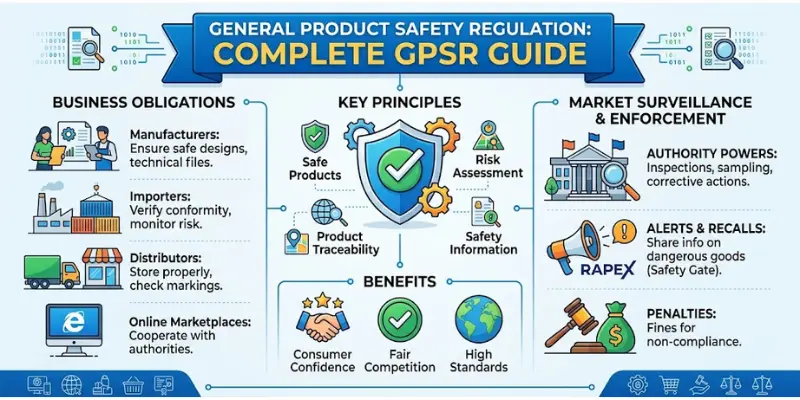
The regulation is particularly important because consumers now purchase products through websites, marketplaces, social-commerce platforms, and other digital channels. As a result, product safety is no longer limited to physical stores and traditional supply chains. The General Product Safety Regulation introduces responsibilities for manufacturers, importers, distributors, fulfilment service providers, authorized representatives, and online marketplaces.
For businesses, understanding GPSR is essential because compliance involves more than simply producing a safe product. Companies may also need to conduct risk assessments, prepare technical documentation, provide traceability information, communicate safety warnings, monitor products after they reach the market, report dangerous products, and take corrective action when necessary.
This guide explains what the General Product Safety Regulation means, who it applies to, what products are covered, the major requirements for businesses, online selling obligations, labeling and traceability rules, recalls, and practical steps companies can take to improve compliance.
What Is the General Product Safety Regulation?
The General Product Safety Regulation (GPSR) is Regulation (EU) 2023/988, an EU-wide legal framework intended to ensure that consumer products made available on the European Union market are safe. It was adopted on 10 May 2023, entered into force on 12 June 2023, and became applicable on 13 December 2024.
The regulation replaced the General Product Safety Directive 2001/95/EC and was designed to address changes in technology, international supply chains, online shopping, connected products, and modern consumer behavior.
Unlike a directive, the General Product Safety Regulation is directly applicable across EU Member States. This provides a more consistent legal framework for product safety across the EU.
The regulation functions as a general safety framework. In simple terms, businesses should not place or make available consumer products on the EU market unless those products meet the applicable safety requirements.
The regulation is especially relevant to products that are not completely covered by more specific EU product safety legislation. Where sector-specific legislation applies, the General Product Safety Regulation can still address additional safety risks and aspects that are not already covered by those specific rules.
Businesses that want a broader understanding of protective products can also review this guide to the definition of safety equipment, which explains how safety equipment and protective systems help reduce exposure to hazards.
When Did the General Product Safety Regulation Become Applicable?
The General Product Safety Regulation became applicable on 13 December 2024. This date is important because businesses selling products in the EU should now assess their products and processes against the requirements of Regulation (EU) 2023/988.
The regulation was introduced to replace an older framework that was created before today’s digital marketplace became widespread. The EU therefore designed the new rules to address both conventional retail and modern online commerce.
The European Commission explains that the regulation covers a wider range of products and introduces stronger responsibilities for economic operators, online marketplaces, risk assessment, traceability, and consumer information.
The regulation also strengthens the connection between product safety and digital technologies. For example, safety assessments can consider cybersecurity features and certain evolving, learning, or predictive functionalities where these characteristics affect product safety.
Therefore, businesses should not consider GPSR compliance as simply an updated version of older product safety paperwork. It represents a broader approach to product safety throughout the product lifecycle.
Why Was the General Product Safety Regulation Introduced?
The main purpose of the General Product Safety Regulation is to provide consumers with a high level of protection against dangerous products while creating a more consistent framework for businesses operating in the EU market.
Consumer purchasing habits have changed significantly. Products are now frequently sold through international websites and online marketplaces, allowing businesses outside the EU to sell directly to European consumers.
At the same time, products have become more technologically advanced. Connected devices, software-dependent products, artificial intelligence features, and products capable of changing their behavior can create safety considerations that were less prominent under older legislation.
Another important factor is the growth of direct-to-consumer international commerce. A consumer may purchase a product from a seller located outside the EU without ever interacting with a traditional importer or local retailer.
The General Product Safety Regulation therefore strengthens responsibilities throughout the supply chain and provides specific requirements for distance sales and online marketplaces.
According to the European Commission, the regulation also improves market surveillance and consumer access to information about dangerous non-food products. The EU Safety Gate system plays an important role in sharing information about dangerous products and corrective measures.
What Products Does the General Product Safety Regulation Cover?
The General Product Safety Regulation generally applies to consumer products placed or made available on the EU market when they are not fully governed by other specific EU product safety legislation.
An important feature is that the regulation can cover new, used, repaired, and reconditioned products. It can also apply whether products are sold for payment or made available free of charge in the course of commercial activity.
The regulation applies to products sold through physical stores as well as products offered through websites, online marketplaces, and other distance-selling channels.
The safety assessment is broader than simply checking whether a product works. Businesses may need to consider characteristics such as design, composition, packaging, instructions, warnings, presentation, foreseeable use, reasonably foreseeable misuse, vulnerable consumers, and interactions with other products.
For connected products, relevant cybersecurity characteristics may also need to be considered where they affect safety.
However, the General Product Safety Regulation contains specific exclusions. These include certain medicinal products, food and feed, living plants and animals, plant protection products, some transport equipment operated by service providers, certain aircraft, antiques, and products clearly marked as requiring repair or reconditioning before use.
Businesses should always determine whether another sector-specific regulation applies to their particular product before deciding how GPSR requirements affect them.
Who Must Comply With the General Product Safety Regulation?
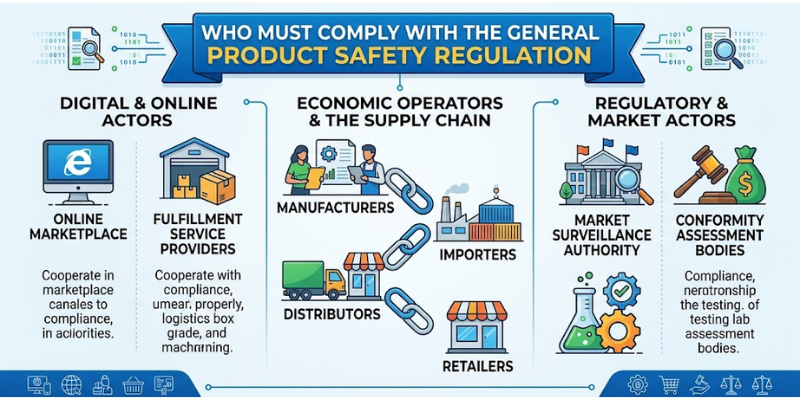
The General Product Safety Regulation places responsibilities on different economic operators involved in the supply chain.
Manufacturers have some of the most extensive responsibilities because they are responsible for ensuring that their products meet the general safety requirement.
Importers have duties when bringing products from outside the EU into the EU market. They must perform appropriate checks and ensure that the required information and documentation are available.
Distributors also have responsibilities. They must act with due care and should not make products available when they know, or should reasonably presume, that those products do not comply with applicable safety requirements.
Authorized representatives can perform certain responsibilities on behalf of manufacturers when properly appointed.
Fulfilment service providers can also have responsibilities under the regulation, particularly where their activities involve storing, packaging, addressing, or dispatching products.
Online marketplaces have specific responsibilities because digital platforms can play a major role in how unsafe products reach consumers.
Consequently, GPSR compliance is not limited to the manufacturer. Every relevant business in the supply chain should understand its own responsibilities.
What Are the Main Requirements of the General Product Safety Regulation?
One of the central requirements is that businesses should only place or make available safe products on the EU market.
However, determining whether a product is safe involves a structured assessment. Businesses should consider the product’s characteristics, design, technical features, composition, packaging, instructions, warnings, consumer expectations, foreseeable use, and other relevant factors.
Manufacturers are expected to carry out an internal risk analysis and prepare technical documentation relevant to product safety.
The documentation should provide evidence that the manufacturer has considered relevant risks and adopted appropriate measures to eliminate or reduce them.
Businesses should also establish processes for monitoring complaints, accidents, safety issues, and other information that may indicate emerging risks.
Where a product is found to be dangerous, appropriate action may include warning consumers, correcting the product, withdrawing it from the market, recalling it, or taking another suitable corrective measure.
These requirements demonstrate that product safety is not simply a one-time test performed before a product is sold. It is an ongoing process.
What Is the GPSR Risk Assessment Requirement?
Risk assessment is one of the most important parts of the General Product Safety Regulation.
Before placing a product on the EU market, manufacturers should conduct an internal risk analysis that identifies potential hazards and evaluates how those hazards could affect consumers.
The assessment should consider the product’s design, materials, construction, intended purpose, foreseeable use, foreseeable misuse, packaging, instructions, warnings, and relevant consumer groups.
For example, a product designed for children may require a different safety assessment from a product designed exclusively for adults. Similarly, a connected product may have additional safety considerations related to software, cybersecurity, or changing functionality.
The manufacturer should document the hazards identified and the measures used to eliminate or reduce those risks.
Relevant standards can also be important. Compliance with applicable European standards referenced under the relevant EU framework can support the safety assessment for the risks covered by those standards.
However, businesses should not assume that simply having a certification or test report automatically makes every product compliant with the General Product Safety Regulation. The complete product, its intended use, applicable legislation, and specific risks should be considered.
What Is Technical Documentation Under GPSR?
Technical documentation provides evidence of how a business assessed and addressed product safety.
For a manufacturer, this documentation can include a general description of the product, essential safety characteristics, the internal risk analysis, applicable standards, testing information, and details of measures taken to control identified risks.
The documentation should be sufficiently detailed to demonstrate how the product meets the applicable safety requirements.
Good documentation also makes it easier for businesses to respond to questions from market surveillance authorities.
Companies should establish a reliable system for storing and maintaining product safety information. Documentation should not be scattered across different employees, email accounts, or disconnected systems.
A well-organized technical file can also make product updates easier because businesses can identify which safety assumptions, tests, materials, components, and standards may need to be reviewed when a product changes.
What Are the Product Labeling and Traceability Requirements?
Product identification and traceability are important parts of the General Product Safety Regulation.
Depending on the product, manufacturers may need to provide information such as a type, batch, serial number, model number, or another identifier that allows the product to be identified.
Manufacturers must also provide relevant business identification and contact information. Where necessary, safety instructions and warnings should be provided in a form that consumers can understand.
The exact method of providing information depends on the product and circumstances. Information may need to appear directly on the product or, where that is not practical, on its packaging or accompanying documentation.
Traceability is important because authorities and businesses need to be able to identify products when a safety problem occurs.
For consumers, clear identification also makes it easier to determine whether a particular item is affected by a safety warning or recall.
Businesses should therefore treat labeling as a core product safety activity rather than as a marketing detail.
What Is the EU Responsible Person Under GPSR?
One of the major changes introduced by the General Product Safety Regulation is the requirement for a responsible economic operator established in the EU for covered products.
This is particularly important for businesses located outside the European Union.
The responsible person can, depending on the circumstances, be an EU-based manufacturer, importer, authorized representative, or fulfilment service provider.
The responsible person has defined compliance-related responsibilities and must be identifiable through the relevant product or accompanying information.
For a non-EU manufacturer selling directly to European consumers, this requirement can be particularly important because simply having an overseas manufacturer is not enough.
Businesses should determine who the responsible person is, document that relationship, and ensure that the required information is correctly provided.
This requirement also demonstrates why international sellers should review their EU supply-chain structure before offering products to European consumers.
How Does the General Product Safety Regulation Affect Online Sellers?
Online commerce is one of the most important areas addressed by the General Product Safety Regulation.
Under the distance-selling requirements, online product offers must provide consumers with important product and safety information before they complete a purchase.
Depending on the circumstances, this can include the manufacturer’s name and contact information, information about the EU responsible person where required, product identification details, and relevant warnings or safety information.
This means a product page is no longer simply a marketing page. It can also be an important product safety compliance point.
Businesses should review their online listings and check whether required information is clearly visible before purchase.
Product images, descriptions, safety warnings, operator information, and identification information should be reviewed carefully.
A common mistake is to assume that because information exists somewhere on the company’s website, the online product offer automatically meets the requirements. Businesses should instead evaluate whether the required information is presented appropriately at the point of sale.
What Does GPSR Mean for Online Marketplaces?
The General Product Safety Regulation introduces specific obligations for providers of online marketplaces.
Online marketplaces can play a major role in preventing unsafe products from reaching consumers. Therefore, the regulation requires platforms to cooperate with market surveillance authorities and follow specific product safety procedures.
Marketplaces have responsibilities relating to registration, contact points, product safety information, cooperation with authorities, and handling information about dangerous products.
This is significant for sellers using major online platforms because marketplace compliance requirements may influence whether a product listing can remain active.
Businesses should therefore avoid treating marketplace requirements as completely separate from legal product safety compliance.
Instead, sellers should ensure that their product documentation, operator information, warnings, identification details, and safety records are ready before listing products.
What Happens If a Product Is Found to Be Unsafe?
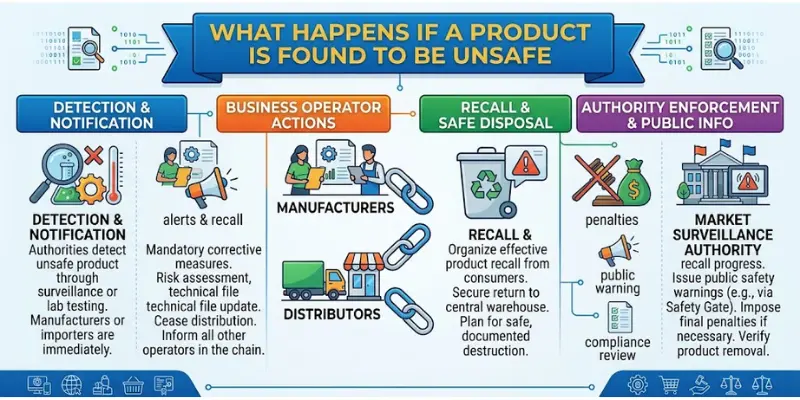
If a business discovers that a product may be dangerous, it should not simply continue selling the product and wait for a regulator or consumer to raise the issue.
The General Product Safety Regulation establishes mechanisms for businesses to report dangerous products and take corrective action.
Depending on the circumstances, corrective measures may include stopping sales, withdrawing products from distribution, warning consumers, repairing products, replacing products, or recalling products.
Businesses should maintain internal procedures that explain who is responsible for handling product safety incidents.
They should also establish communication procedures for contacting suppliers, distributors, marketplaces, authorities, and affected consumers when necessary.
A well-prepared recall process can significantly reduce confusion when a serious safety problem occurs.
How Do Product Recalls Work Under GPSR?
Product recalls are an important part of consumer protection under the General Product Safety Regulation.
When a product presents a safety risk that requires corrective action, businesses may need to communicate directly with affected consumers and provide an appropriate remedy.
The regulation strengthens consumer rights by requiring effective corrective measures and provides specific expectations concerning remedies in recall situations.
Businesses should maintain accurate records that allow them to identify affected products and, where possible, the consumers or distribution channels involved.
Traceability therefore becomes extremely important during a recall.
Companies should also prepare recall communications in clear language. A vague announcement may not give consumers enough information to identify the dangerous product or understand what action they should take.
A good recall process should identify the product, explain the safety concern, identify the affected units or batches where possible, tell consumers what to do, and explain the available remedy.
What Is Safety Gate?
Safety Gate is the European Union’s rapid alert system for dangerous non-food products.
It allows information about dangerous products and corrective measures to be shared among relevant authorities and made available to consumers.
Safety Gate is important because a product identified as dangerous in one EU market can trigger action and information sharing across the broader European system.
For businesses, monitoring product safety developments can provide useful information about emerging hazards, unsafe product categories, and regulatory enforcement.
Consumers can also use Safety Gate information to stay informed about dangerous non-food products.
The General Product Safety Regulation strengthens the role of Safety Gate within the wider European product safety framework.
What Are the Penalties for Non-Compliance?
The consequences of product safety non-compliance can vary depending on the nature of the violation, the Member State involved, the seriousness of the risk, and the applicable enforcement measures.
Possible consequences can include product withdrawals, recalls, restrictions on making products available, marketplace removal, corrective actions, and financial penalties under applicable national enforcement frameworks.
For businesses, the commercial consequences can be significant even when a penalty is not the primary issue.
A product safety problem can result in lost sales, damaged reputation, increased logistics costs, customer complaints, marketplace restrictions, and expensive recalls.
Therefore, compliance should be treated as part of risk management rather than simply a legal formality.
General Product Safety Regulation vs Great Britain Rules
The General Product Safety Regulation should not be confused with the General Product Safety Regulations 2005 that currently apply in Great Britain.
The EU regulation applies in the EU and also has relevance in Northern Ireland under the applicable framework. Great Britain, covering England, Scotland, and Wales, continues to operate under the General Product Safety Regulations 2005.
The UK government explains that the 2005 Regulations require consumer products covered by the framework to be safe under normal or reasonably foreseeable conditions of use.
The GB framework includes obligations for producers and distributors, including product safety, consumer information, traceability, monitoring, notification of risks, and cooperation with enforcement authorities.
This distinction is extremely important for businesses selling products in both the EU and Great Britain.
A company should not automatically assume that satisfying one jurisdiction’s product safety requirements means that it has satisfied every requirement in another jurisdiction.
Businesses operating internationally should therefore map their products against the rules applicable in each market.
The UK government’s General Product Safety Regulations 2005 guidance provides further information for businesses supplying products in Great Britain.
How Can Businesses Comply With the General Product Safety Regulation?
The first step is to identify every product that may fall within the scope of the General Product Safety Regulation.
Next, businesses should determine which product-specific EU legislation also applies. This is important because some products are subject to more detailed sector-specific requirements.
After establishing the applicable legal framework, manufacturers should conduct appropriate risk assessments and prepare technical documentation.
The next step is to review product labeling and traceability. Businesses should verify that product identifiers, manufacturer information, responsible-person details where required, warnings, and safety instructions are correctly provided.
Online sellers should then review every relevant product listing. Product pages should be checked for the information required for distance sales.
Businesses should also establish procedures for complaints, accidents, dangerous products, corrective actions, and recalls.
Supplier and distributor relationships should be reviewed as well. Companies should know who manufactures products, where products are produced, who imports them, who distributes them, and who performs fulfilment activities.
Finally, compliance should be reviewed whenever a product changes. Changes to design, materials, components, software, packaging, warnings, manufacturing processes, or intended use can affect the safety assessment.
A Practical GPSR Compliance Checklist
A practical compliance process can begin with a complete product inventory. Businesses should identify the products sold or intended to be sold in the EU and determine which ones fall under the General Product Safety Regulation.
The next stage is product classification. Companies should identify relevant sector-specific laws and determine whether GPSR applies fully or addresses additional risks not covered elsewhere.
Businesses should then complete internal risk assessments and maintain appropriate technical documentation.
Product labels should be reviewed for identification, manufacturer information, traceability, instructions, and safety warnings.
For non-EU manufacturers, the responsible economic operator in the EU should be identified and documented.
Online product listings should be reviewed to ensure that required safety and operator information is presented before purchase.
Companies should establish complaint-handling and incident-reporting procedures and maintain records of relevant product safety information.
Finally, organizations should create a recall and corrective-action procedure so they can respond quickly if a dangerous product is discovered.
Common GPSR Compliance Mistakes
One common mistake is treating the General Product Safety Regulation as a simple labeling requirement. In reality, GPSR compliance covers product safety, risk assessment, documentation, traceability, economic operators, online selling, monitoring, reporting, and corrective action.
Another mistake is assuming that CE marking alone proves compliance with every GPSR requirement. CE marking applies under specific EU legislation and is not a universal substitute for the General Product Safety Regulation’s broader requirements.
Businesses can also make mistakes by failing to identify the correct EU responsible person.
Online sellers sometimes overlook the information that must be displayed on product offers before consumers purchase products.
Another problem is inadequate documentation. A company may have tested a product but fail to maintain an organized record explaining the risks considered, standards applied, testing performed, and safety measures adopted.
Finally, some businesses fail to prepare for post-market problems. Product safety should continue after a product reaches consumers because complaints, incidents, changing information, or newly identified hazards can reveal risks that were not previously understood.
Why Is GPSR Important for Consumers?
For consumers, the General Product Safety Regulation provides an additional layer of protection when purchasing products in the European market.
The regulation recognizes that consumers buy products through many different channels and that product safety information needs to remain accessible in modern shopping environments.
Clear product identification and safety information can help consumers make informed purchasing decisions.
Stronger market surveillance can also help authorities identify dangerous products and coordinate corrective action.
The regulation’s approach to online commerce is particularly important because consumers should receive relevant safety information even when they purchase products without visiting a physical store.
Ultimately, the goal is to ensure that innovation, international commerce, and digital retail do not come at the expense of consumer safety.
How Can Businesses Stay Updated With Product Safety Requirements?
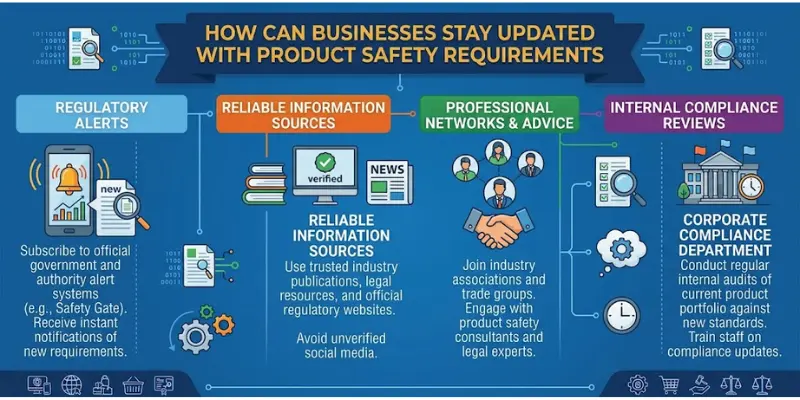
Product safety requirements can change as technology, standards, enforcement practices, and legislation develop.
Businesses should therefore monitor official European Commission information, EUR-Lex, Safety Gate, relevant national market surveillance authorities, and applicable standards.
Companies should also maintain an internal process for reviewing regulatory updates.
When a new requirement becomes relevant, the business should determine which products, technical files, labels, online listings, suppliers, and procedures are affected.
This approach is more effective than waiting until a marketplace, customer, or regulator identifies a compliance problem.
Organizations can also strengthen their overall safety knowledge through structured safety training, especially when employees are responsible for inspections, product handling, risk management, or safety procedures.
Frequently Asked Questions About the General Product Safety Regulation
What is the General Product Safety Regulation?
The General Product Safety Regulation is EU Regulation 2023/988, which establishes a general framework for ensuring that consumer products placed or made available on the EU market are safe. It applies from 13 December 2024 and replaced the previous General Product Safety Directive 2001/95/EC.
Who needs to comply with GPSR?
Manufacturers, importers, distributors, authorized representatives, fulfilment service providers, online marketplaces, and other relevant economic operators can have responsibilities under GPSR depending on their role in the supply chain.
Does GPSR apply to products sold online?
Yes. The regulation specifically addresses distance sales and online marketplaces. Online product offers must provide consumers with relevant product identification, operator information, warnings, and safety information as required.
Does GPSR apply to businesses outside the EU?
It can. A business does not have to be established inside the EU to fall within the scope of the regulation when its products are placed or made available on the EU market.
What is the EU responsible person?
The responsible person is an economic operator established in the EU who performs defined product safety compliance tasks under the regulation. Depending on the circumstances, this can be an EU manufacturer, importer, authorized representative, or fulfilment service provider.
Does GPSR apply to used products?
Yes. The regulation can apply to new, used, repaired, and reconditioned products placed or made available on the EU market, subject to its scope and exclusions.
Does GPSR replace CE marking?
No. GPSR and CE-marking requirements are not interchangeable. CE marking applies under specific EU legislation where required, while GPSR establishes general product safety requirements and can complement sector-specific legislation.
What is Safety Gate?
Safety Gate is the EU rapid alert system for dangerous non-food products. It helps authorities exchange information about dangerous products and corrective actions.
Does GPSR apply in Great Britain?
The EU General Product Safety Regulation is not the general product safety framework for Great Britain. England, Scotland, and Wales currently operate under the General Product Safety Regulations 2005, while Northern Ireland follows the applicable EU framework.
Why is risk assessment important under GPSR?
Risk assessment helps manufacturers identify potential hazards and document the measures used to eliminate or reduce those risks. It is a fundamental part of demonstrating product safety.
Conclusion
The General Product Safety Regulation represents a major update to the European Union’s approach to consumer product safety. Regulation (EU) 2023/988 applies from 13 December 2024 and introduces a modern framework that reflects today’s online marketplaces, international supply chains, connected products, and changing technologies.
For businesses, compliance means more than producing a product that appears safe. Companies should understand their responsibilities, identify applicable legislation, conduct appropriate risk assessments, maintain technical documentation, provide traceability information, use appropriate warnings, identify the required EU responsible person, and review online product listings.
Furthermore, businesses should establish systems for monitoring complaints and safety issues and should be prepared to take corrective action when a product presents a risk.
The distinction between EU GPSR and Great Britain’s General Product Safety Regulations 2005 is also important for businesses selling across both markets. Different jurisdictions can impose different responsibilities, so companies should evaluate each market separately.
Ultimately, the best approach to the General Product Safety Regulation is proactive compliance. Businesses that integrate product safety into design, documentation, labeling, online sales, supply-chain management, monitoring, and recall procedures are better positioned to protect consumers and reduce regulatory and commercial risks.
For additional information, businesses should consult the official EUR-Lex General Product Safety Regulation summary, the European Commission’s GPSR information, and current national guidance applicable to the markets where products are sold.
Please Write Your Comments