What Is Safety Regulation? Types, Purpose, Examples, and Importance
Updated: 4-Oct-2026
24
Safety is an essential part of every workplace, industry, public facility, construction project, manufacturing process, and daily activity. People can be exposed to physical, chemical, electrical, mechanical, biological, fire, environmental, and other hazards if appropriate controls are not established. This is why governments, regulatory agencies, industry organizations, and businesses develop rules that define how hazards should be identified, controlled, and managed.
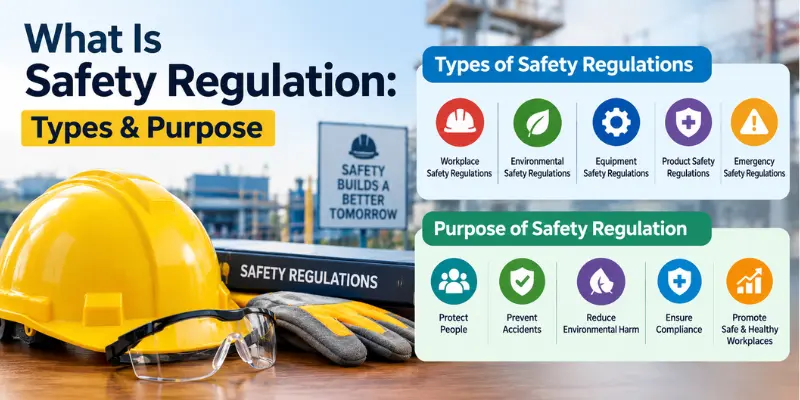
So, what is safety regulation? A safety regulation is a legally enforceable rule, requirement, or prescribed control established by a government authority or authorized regulatory body to reduce risks and protect people, property, and the environment from hazards. Depending on the jurisdiction and subject, regulations may address workplace conditions, equipment, construction, electrical systems, fire protection, chemicals, transportation, consumer products, environmental risks, and emergency preparedness.
Safety regulations provide a structured framework for turning general safety objectives into specific requirements. Instead of simply telling an organization to “work safely,” a regulation may establish requirements for equipment, training, inspections, protective measures, emergency procedures, documentation, reporting, or maintenance. The exact requirements depend on the country, industry, workplace, and hazard involved.
For organizations, understanding safety regulation is important because compliance is not only about avoiding penalties. Effective regulations help reduce accidents, occupational injuries, illnesses, property damage, and unsafe practices. They also establish clear responsibilities for employers, employees, contractors, manufacturers, supervisors, and other parties involved in potentially hazardous activities.
What Is Safety Regulation?
Safety regulation refers to a formal rule or requirement created to control hazards and establish minimum levels of safety. Regulations may be issued directly through legislation or by government agencies that have legal authority to develop and enforce detailed requirements.
In simple terms, safety regulation tells people and organizations what safety requirements they must follow when carrying out particular activities. For example, a workplace regulation may require employers to provide appropriate protective equipment, maintain machinery, control hazardous substances, provide training, or establish emergency procedures.
The exact meaning of a safety regulation varies according to the legal system and industry. A construction regulation may focus on scaffolding, fall protection, excavation, electrical hazards, machinery, and personal protective equipment. A chemical safety regulation may focus on labeling, storage, handling, exposure controls, and emergency response. A fire safety regulation may establish requirements for alarms, exits, extinguishers, emergency lighting, evacuation arrangements, and fire prevention.
The important point is that regulations are designed around specific risks. They provide measurable requirements that organizations can use to determine whether their operations meet applicable legal safety obligations.
ScienceDirect describes regulations as rules issued by regulatory authorities to interpret and apply laws and help organizations achieve compliance. It also notes that safety regulations can address equipment, management systems, operating methods, emergency arrangements, and responsibilities.
For a broader foundation, you can also read our guide to [the definition of safety equipment Definition of Safety Equipment, which explains how protective equipment fits into a wider safety program.
Why Are Safety Regulations Important?
The main purpose of safety regulation is to reduce unacceptable risks before they result in injuries, fatalities, property damage, environmental harm, or other losses. Regulations establish a baseline that organizations are expected to meet instead of allowing every employer or business to decide independently what level of protection is sufficient.
One major benefit is accident prevention. When organizations follow requirements for machine guarding, electrical safety, fire protection, fall protection, chemical handling, or other hazards, workers have greater protection from predictable sources of harm.
Safety regulations also clarify responsibilities. Employers may be required to provide safe working conditions, maintain equipment, train employees, conduct assessments, and provide appropriate protective measures. Employees may have responsibilities to follow established procedures, use protective equipment correctly, report hazards, and cooperate with safety programs.
Another important benefit is consistency. Without formal requirements, similar workplaces could apply completely different safety practices. Regulations establish minimum expectations that help create a consistent approach to hazard control.
Safety regulation can also improve emergency preparedness. Requirements relating to emergency exits, alarms, fire protection, first aid, emergency communication, evacuation plans, and rescue procedures help organizations prepare before an incident occurs.
In addition, compliance can protect businesses from legal and financial consequences. Depending on the jurisdiction and severity of a violation, non-compliance may result in inspections, notices, fines, corrective orders, civil liability, or other legal consequences.
However, compliance should not be viewed as the final goal of safety management. A strong organization uses regulations as a baseline and continuously looks for ways to identify hazards and reduce risk beyond the minimum requirement.
What Are the Main Types of Safety Regulations?
Safety regulation covers a very broad range of activities. The exact categories differ between countries, but several major areas appear across many industries.
Workplace safety regulations are designed to protect employees from hazards associated with their jobs. These may cover machine safety, electrical hazards, chemicals, noise, ergonomics, respiratory hazards, fall protection, personal protective equipment, emergency preparedness, and workplace conditions.
Construction safety regulations focus on risks associated with construction activities. They commonly address excavation, scaffolding, ladders, cranes, lifting operations, electrical systems, fall protection, demolition, personal protective equipment, and site housekeeping.
Fire safety regulations establish requirements intended to prevent fires and protect people when fires occur. These can include fire detection, alarms, extinguishing systems, emergency exits, evacuation plans, fire-resistant construction, emergency lighting, inspections, and maintenance.
Electrical safety regulations address hazards associated with electrical installations, equipment, wiring, energized systems, grounding, overcurrent protection, isolation, and maintenance. Their objective is to reduce electric shock, burns, arc-flash incidents, fires, and equipment damage.
Chemical safety regulations control the handling, storage, labeling, transportation, and disposal of hazardous substances. Depending on the substance and jurisdiction, organizations may also have requirements related to exposure monitoring, safety data sheets, emergency response, and worker training.
Product safety regulations protect consumers and users from unsafe products. These requirements can address design, manufacture, testing, labeling, warnings, instructions, packaging, and product recalls.
Transportation safety regulations apply to vehicles, roads, aviation, railways, shipping, and other transportation systems. Their requirements vary significantly depending on the mode of transportation and jurisdiction.
Environmental safety regulations may control hazardous waste, emissions, pollution, contaminated materials, chemical releases, and other activities that could harm people or the environment.
These categories can overlap. For example, a manufacturing facility may need to comply simultaneously with workplace, fire, electrical, chemical, environmental, and machinery-related safety regulations.
Safety Regulations vs Safety Standards
Safety regulations and safety standards are closely related, but they are not always the same thing.
A regulation is generally a legal requirement established or enforced by a government or regulatory authority. A safety standard is often a technical specification, consensus document, or best-practice framework developed by a standards organization or professional body.
The legal status of a standard depends on the applicable jurisdiction. A standard may be voluntary in one situation but become legally relevant when it is incorporated into legislation, referenced by a regulation, required by contract, or adopted by an authority.
ISO 45001 is a useful example. It is an international standard for occupational health and safety management systems. ISO explains that it provides a framework for managing occupational health and safety risks, including leadership, worker participation, hazard identification, risk assessment, legal compliance, emergency planning, incident investigation, and continual improvement.
Therefore, organizations should not automatically assume that every standard is a law or that every regulation is an international standard. They should determine which requirements are legally applicable to their particular activities and location.
You can also review our article on [standard safety equipment and standard safety measures Standard Safety Equipment and Standard Safety Measures for more information about how standards and safety measures relate to protective equipment.
Safety Regulation vs Safety Policy
A safety policy is another concept that is often confused with a regulation.
A safety policy is an organization’s formal statement of its commitment, objectives, responsibilities, and approach to managing safety. A company may create a policy stating that it will provide safe working conditions, identify hazards, train employees, investigate incidents, and continually improve safety performance.
A safety regulation, in contrast, is an external requirement that may have legal authority.
For example, a company may have a policy requiring all employees to report unsafe conditions. At the same time, applicable regulations may require specific incident reporting, workplace inspections, training, or recordkeeping.
A good safety management system connects the two. Regulations establish applicable legal requirements, while the organization’s policies and procedures explain how those requirements will be implemented in daily operations.
What Do Safety Regulations Usually Cover?
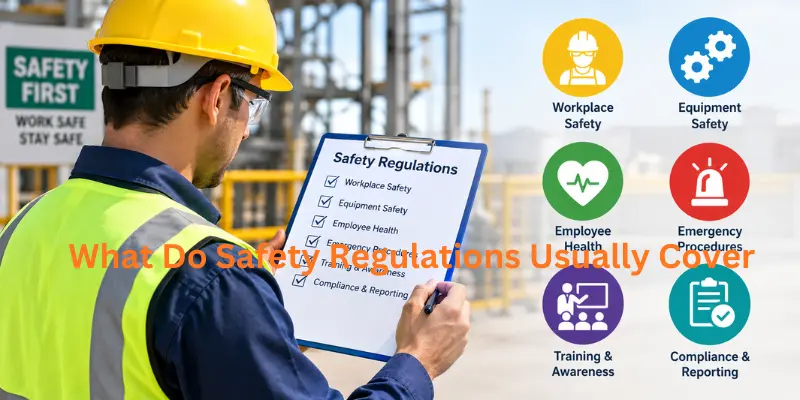
Although requirements vary by industry, many safety regulations address similar fundamental areas.
Hazard identification is one of the most important areas. Organizations need to recognize potential sources of injury, illness, property damage, or environmental harm.
Risk assessment is another major component. Identifying a hazard is not enough; organizations often need to evaluate the likelihood and potential severity of an incident and determine appropriate controls.
Safety training is also commonly addressed. Workers need to understand the hazards associated with their jobs, the procedures they must follow, the equipment they must use, and what to do during emergencies.
Personal protective equipment may be required when hazards cannot be adequately controlled through other measures. Depending on the task, this may include helmets, safety glasses, gloves, protective clothing, safety footwear, hearing protection, or respiratory protection.
Equipment inspection and maintenance are also important because defective equipment can create additional hazards. Organizations may need documented inspection programs for machinery, electrical systems, lifting equipment, fire protection systems, PPE, and other safety-critical equipment.
Emergency preparedness is another common area. Regulations may establish requirements for evacuation, emergency communication, first aid, fire response, rescue, spill response, or other emergency activities.
Recordkeeping and reporting requirements may also apply. Depending on the jurisdiction, organizations may have to document injuries, illnesses, inspections, training, incidents, maintenance, exposure monitoring, or corrective actions.
How Do Safety Regulations Work?
Safety regulations generally work through a combination of legal requirements, technical criteria, inspections, enforcement, training, documentation, and corrective actions.
First, a government or regulatory authority identifies a safety problem or establishes a legal framework for controlling a particular risk. Detailed requirements may then be developed through a formal regulatory process.
Once a regulation becomes applicable, organizations must determine which requirements apply to their operations. This can involve reviewing the regulation, identifying affected activities, conducting hazard assessments, and comparing existing procedures against regulatory requirements.
The organization then implements controls. These may include engineering changes, administrative procedures, training, equipment modifications, PPE programs, emergency plans, inspection schedules, and maintenance systems.
Regulatory authorities may inspect workplaces or investigate incidents to determine whether requirements are being followed. Where violations are identified, the organization may be required to correct them.
In the United States, for example, OSHA maintains official laws and regulations covering areas such as general industry, construction, maritime, agriculture, recordkeeping, and other workplace safety matters. OSHA also states that employers must comply with applicable OSHA standards and the General Duty Clause.
Examples of Safety Regulations in the Workplace
Workplace safety regulations can affect almost every aspect of an organization’s operations.
Consider a construction site. Workers may face fall hazards, moving equipment, electrical hazards, falling objects, excavation hazards, dust, noise, and hazardous materials. Applicable regulations may require fall protection, safe access, equipment inspection, training, PPE, emergency arrangements, and other controls.
OSHA’s construction regulations, for example, include requirements covering general safety and health provisions, training, first aid, fire protection, housekeeping, and PPE.
In a manufacturing facility, regulations may address machine guarding, hazardous energy, electrical systems, chemicals, noise, emergency exits, fire protection, PPE, and workplace conditions.
In a laboratory, safety requirements may focus on chemical exposure, biological hazards, compressed gases, electrical equipment, emergency showers, eye protection, ventilation, waste handling, and emergency response.
In an office, risks may appear less severe but safety requirements can still apply. Fire protection, emergency exits, electrical safety, ergonomics, indoor conditions, slips and trips, and emergency preparedness may all require attention.
For workers dealing with airborne hazards, an appropriate respiratory protection program may also be necessary. Our detailed guide to [respiratory protection Respiratory Protection Guide explains different forms of respiratory protective equipment and relevant standards.
What Happens When Safety Regulations Are Not Followed?
Failure to follow applicable safety regulations can expose people and organizations to serious consequences.
The most important consequence is increased risk of injury or illness. A regulation usually exists because a particular hazard has the potential to cause harm. Ignoring the requirement can therefore increase the likelihood of an incident.
Non-compliance can also result in regulatory action. Depending on the jurisdiction, authorities may conduct inspections, issue notices, impose penalties, require corrective actions, or take other enforcement measures.
There may also be operational consequences. A serious incident can cause equipment damage, production interruptions, investigation costs, worker absence, reputational damage, and increased insurance costs.
In severe cases, non-compliance may contribute to fatalities or major environmental incidents.
However, safety regulations should not be treated simply as a collection of penalties and legal obligations. Their fundamental purpose is preventive. Following requirements helps organizations identify foreseeable hazards and establish controls before people are harmed.
What Is the Role of PPE in Safety Regulations?
Personal protective equipment, commonly called PPE, is an important part of many safety programs.
PPE includes equipment worn or used by workers to reduce exposure to hazards. Examples include safety helmets, gloves, goggles, face shields, protective clothing, safety footwear, hearing protection, and respirators.
The appropriate PPE depends on the hazard. Chemical handling may require chemical-resistant gloves and eye or face protection. Construction work may require head protection, high-visibility clothing, safety footwear, and fall protection. Welding may require appropriate eye and face protection and protective clothing.
However, PPE should not automatically be considered the first or only control. A strong safety program considers ways to eliminate or reduce hazards through design, engineering controls, safe work practices, and administrative measures before relying on PPE where appropriate.
Our guide to [emergency personal protective equipment Emergency Personal Protective Equipment explains why PPE selection should be based on the hazard, exposure route, task, working conditions, fit, and compatibility.
Similarly, our [purpose of safety equipment Purpose of Safety Equipment guide explains how different safety equipment helps reduce exposure to workplace hazards.
How Can Businesses Comply With Safety Regulations?
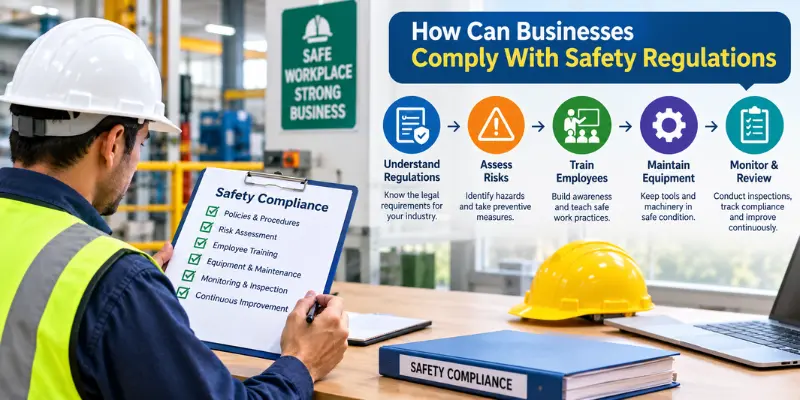
Compliance should be treated as an ongoing management process rather than a one-time project.
The first step is to identify applicable requirements. Businesses should determine which laws, regulations, codes, standards, permits, and industry requirements apply to their operations.
Next, organizations should identify hazards. A workplace assessment should consider equipment, materials, processes, workers, contractors, environmental conditions, emergency situations, and changes to operations.
After identifying hazards, the organization should determine appropriate controls. Where possible, hazards should be eliminated or reduced through design and engineering controls. Administrative controls and safe work procedures can provide additional protection, while PPE may be required for remaining risks.
Training should then be provided to employees according to their responsibilities and hazards. Training should not simply consist of signing an attendance sheet. Workers should understand the hazards, procedures, equipment, emergency actions, and limitations relevant to their work.
Inspection and maintenance programs should also be established. Safety-critical equipment should remain in suitable working condition, and deficiencies should be corrected promptly.
Organizations should maintain appropriate documentation. Depending on the applicable requirements, records may include training, inspections, risk assessments, incident reports, equipment maintenance, corrective actions, and other compliance information.
Finally, businesses should periodically review their safety programs. Regulations can change, equipment can change, work processes can change, and new hazards can emerge.
Our [safety training guide Safety Training: Complete Workplace Safety Guide provides additional information about training programs, hazard communication, emergency response, PPE, and workplace safety education.
Safety Regulations and the Hierarchy of Controls
Safety regulations often work best when organizations use a systematic approach to hazard control.
The hierarchy of controls is commonly used to prioritize methods for reducing hazards. Elimination is generally preferred because it removes the hazard. Substitution replaces a hazardous material or process with something less hazardous. Engineering controls isolate people from hazards. Administrative controls change the way work is organized or performed. PPE provides personal protection when hazards remain.
For example, suppose a worker is exposed to excessive machine noise. Simply giving the worker hearing protection may reduce exposure, but a stronger approach may also investigate whether the noise can be eliminated, reduced through engineering changes, isolated, or controlled through work practices.
The exact control requirements depend on the applicable regulation and hazard. Organizations should therefore avoid assuming that PPE alone satisfies every safety regulation.
This principle is particularly important because regulations can establish minimum legal requirements while effective safety management aims to reduce risk as far as reasonably practicable.
Who Creates and Enforces Safety Regulations?
The organizations responsible for safety regulation differ from one country to another.
Governments may establish laws through legislative bodies. Regulatory agencies may then develop detailed regulations, standards, guidance, or enforcement mechanisms under the authority provided by law.
Some sectors have specialized regulatory authorities. For example, workplace safety may be regulated by a labor or occupational safety authority, while transportation, aviation, nuclear activities, environmental protection, or consumer products may be overseen by different agencies.
In the United States, OSHA is responsible for setting and enforcing many workplace safety and health standards. Its official regulations cover areas including general industry and construction.
International standards organizations also influence safety practices. ISO 45001, for example, provides an internationally recognized framework for occupational health and safety management systems.
Because requirements vary by location, businesses should always verify applicable regulations with the relevant local or national authority rather than assuming that a requirement from another country automatically applies.
Safety Regulation and Risk Management
Safety regulation and risk management are closely connected.
Risk management involves identifying hazards, evaluating risks, selecting controls, implementing those controls, and monitoring whether they remain effective.
Safety regulations provide a legal framework for managing certain risks. They may specify minimum controls, inspection requirements, training requirements, exposure limits, equipment requirements, reporting obligations, or other measures.
However, effective risk management can go beyond legal compliance. A workplace may technically meet a minimum regulatory requirement while still having opportunities to reduce risk further.
For example, an organization may comply with a PPE requirement but discover through a risk assessment that a machine guard, ventilation improvement, automation, or process redesign could reduce exposure more effectively.
ISO 45001 emphasizes systematic hazard identification, risk assessment, legal and regulatory compliance, emergency planning, incident investigation, and continual improvement.
Therefore, safety regulation should be integrated into a broader risk-management process rather than treated as a standalone paperwork exercise.
Why Safety Regulation Matters for Safety Equipment
Safety equipment and safety regulation are closely connected because regulations often establish requirements for the selection, use, inspection, maintenance, or performance of protective equipment.
For example, a workplace may need specific forms of head, eye, hand, respiratory, hearing, or fall protection depending on the hazards identified.
However, choosing safety equipment simply because it looks protective is not enough. Equipment should be appropriate for the specific hazard and task, and organizations should consider fit, compatibility, performance requirements, maintenance, and manufacturer instructions.
Our comprehensive [safety equipment guide Top 20 Companies Producing Safety Equipment provides an overview of different categories of safety equipment, including PPE, fire safety equipment, electrical safety equipment, chemical protection, fall protection, respiratory protection, and first aid equipment.
The goal should always be to select equipment based on a documented hazard assessment and applicable requirements rather than purchasing generic equipment without considering the actual risk.
How Safety Regulations Improve Workplace Safety Culture
A strong safety culture develops when safety becomes part of normal business operations rather than something considered only during inspections.
Safety regulation can support this culture by establishing clear expectations. Employees know what procedures must be followed, supervisors understand their responsibilities, and management can establish measurable safety objectives.
Training, inspections, reporting, incident investigation, emergency exercises, equipment maintenance, and management reviews can reinforce these expectations.
Employees should also be encouraged to report hazards and near misses. A workplace that responds constructively to reported hazards can identify problems before they become serious incidents.
Safety culture is therefore influenced by more than written rules. Leadership commitment, worker participation, communication, training, resources, accountability, and continuous improvement are all important.
Regulations provide the foundation, but organizations determine how effectively that foundation is implemented in everyday work.
Common Mistakes in Safety Regulation Compliance
One common mistake is assuming that having a written safety policy automatically means the organization is compliant. Policies must be implemented through procedures, training, inspections, equipment, supervision, and corrective actions.
Another mistake is using outdated requirements. Regulations can be revised, replaced, or supplemented, so businesses should periodically verify current requirements.
A third mistake is treating PPE as the complete safety solution. PPE is important, but organizations should consider higher-level hazard controls wherever appropriate.
Poor documentation is another problem. If inspections, training, risk assessments, or corrective actions are not documented when records are required, an organization may have difficulty demonstrating compliance.
Businesses may also overlook contractors and temporary workers. Safety responsibilities should be clearly defined for everyone who may be exposed to workplace hazards.
Finally, organizations sometimes focus only on obvious hazards and overlook less visible risks such as ergonomics, noise, airborne contaminants, fatigue, poor housekeeping, or inadequate emergency planning.
How to Stay Updated With Safety Regulations
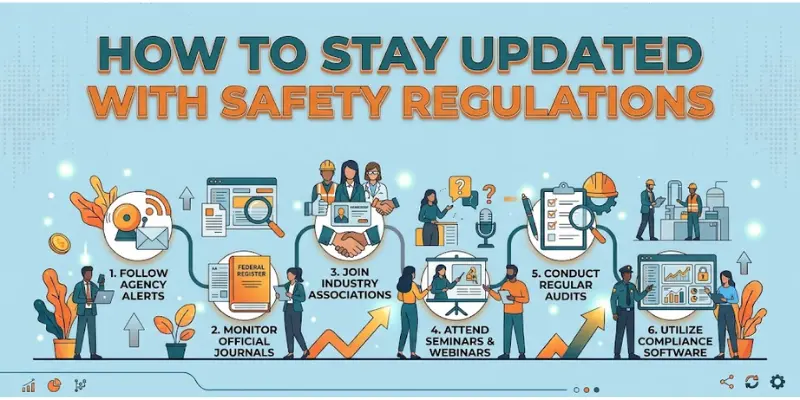
Staying current is essential because safety requirements can change as technology, industry practices, hazards, and legal frameworks evolve.
Businesses should monitor official regulatory authority websites and subscribe to relevant updates where available. They should also periodically review applicable laws, regulations, standards, permits, and internal procedures.
Training materials should be updated when requirements change. Equipment and procedures should also be reviewed whenever new hazards are introduced.
Organizations operating internationally should pay particular attention to jurisdictional differences. A regulation applicable in the United States may not apply in Pakistan, the United Kingdom, Canada, Australia, or another country.
For example, OSHA’s official website provides current U.S. workplace safety laws, regulations, standards, enforcement information, and related resources.
For international occupational health and safety management, organizations can also review the official [ISO 45001 standard information ISO 45001:2018 Occupational Health and Safety Management Systems.
Frequently Asked Questions About Safety Regulation
What is safety regulation in simple words?
Safety regulation is a formal rule or requirement designed to reduce hazards and protect people, property, or the environment. Depending on the jurisdiction, regulations may be legally enforceable and may cover workplaces, products, construction, transportation, chemicals, fire protection, electrical systems, and other activities.
What is the main purpose of safety regulation?
The main purpose is to reduce risks and prevent accidents, injuries, illnesses, fatalities, property damage, and other harmful outcomes. Regulations establish minimum safety requirements and define responsibilities for organizations and individuals.
What are examples of safety regulations?
Examples include workplace safety requirements, construction safety rules, electrical safety requirements, fire safety regulations, chemical handling regulations, machinery safety requirements, product safety rules, and transportation safety requirements.
Are safety regulations legally required?
Many safety regulations are legally enforceable, but the exact legal status depends on the regulation and jurisdiction. Businesses should verify which requirements apply to their specific location and activities.
What is the difference between a safety regulation and a safety standard?
A safety regulation is generally a legal requirement established or enforced by a government authority. A safety standard is usually a technical specification or best-practice framework developed by a standards organization. A standard can become legally relevant when it is incorporated into law or otherwise made applicable.
Why are safety regulations important in the workplace?
They establish minimum requirements for protecting employees from hazards. They can cover training, PPE, equipment, emergency procedures, hazard controls, inspections, recordkeeping, and other safety measures.
Does PPE replace safety regulations?
No. PPE is one component of a broader safety program. Organizations should identify hazards and use appropriate controls, with PPE used where necessary to reduce remaining exposure.
Who is responsible for following safety regulations?
Responsibilities depend on the applicable regulation. Employers, managers, supervisors, workers, contractors, manufacturers, and other parties may have specific responsibilities.
How can a company comply with safety regulations?
A company should identify applicable requirements, assess hazards, implement appropriate controls, provide training, select suitable equipment, inspect and maintain safety systems, document required activities, investigate incidents, and regularly review compliance.
Can safety regulations change?
Yes. Regulations may be amended, replaced, expanded, or supplemented as laws, technology, hazards, and industry practices change. Organizations should monitor official sources for current requirements.
What is ISO 45001?
ISO 45001:2018 is an international standard for occupational health and safety management systems. It provides a framework for managing OH&S risks, legal requirements, emergency planning, worker participation, incident investigation, and continual improvement.
Conclusion
Understanding what is safety regulation is important for anyone responsible for workplace safety, construction, manufacturing, engineering, fire protection, chemical handling, electrical work, transportation, or other activities involving potential hazards.
Safety regulations provide formal requirements for controlling risks and protecting workers, consumers, property, and the environment. They can address everything from PPE and machine safety to emergency preparedness, chemical handling, electrical systems, fire protection, inspections, training, and incident reporting.
The value of safety regulation goes beyond legal compliance. Effective requirements help organizations establish consistent safety practices, identify hazards, reduce exposure, prepare for emergencies, and create clearer responsibilities for everyone involved.
Businesses should therefore treat regulations as an essential part of their safety management system rather than as paperwork completed only before an inspection. Regular hazard assessments, appropriate controls, employee training, equipment maintenance, inspections, documentation, incident investigation, and continuous improvement all contribute to stronger safety performance.
At the same time, organizations should verify requirements with the appropriate regulatory authorities because safety regulations differ by country, industry, activity, and workplace. Following current and applicable requirements is essential.
Ultimately, the purpose of safety regulation is simple: to reduce preventable risk and help people perform activities in safer conditions. When regulatory compliance is combined with effective risk management, suitable safety equipment, competent training, and strong safety leadership, organizations can build safer and more resilient workplaces.
Please Write Your Comments