Fire Safety Regulations: Essential Rules, Standards, and Compliance Requirements
Updated: 15-Oct-2026
8
Introduction
Fire safety regulations play an essential role in protecting people, buildings, equipment, and business operations from fire hazards. These requirements address fire prevention, emergency exits, fire detection systems, firefighting equipment, evacuation planning, and workplace safety procedures. Although the specific rules differ between countries, their primary purpose is to reduce fire risks, protect human life, and limit property damage.
Businesses, property owners, employers, facility managers, and safety professionals need to understand which fire safety regulations apply to their premises. An effective fire safety program combines legal compliance with practical precautions, such as maintaining fire extinguishers, testing alarms, controlling ignition sources, and keeping escape routes accessible. You can also explore our guide to fire safety equipment to understand the equipment commonly used to protect people and workplaces.
However, there is no single set of fire safety regulations that applies identically throughout the world. In the United States, the Occupational Safety and Health Administration (OSHA) establishes important workplace safety requirements. Building and fire codes adopted by state and local authorities may impose additional obligations. In India, the National Building Code of India 2016 provides guidance on fire and life safety, alongside applicable state and local requirements.
International readers must therefore distinguish between general fire prevention principles and legally applicable requirements. This guide explains the main elements of fire safety regulations, highlights important US workplace requirements, covers India’s regulatory framework, and explains how organizations can approach fire safety compliance in different jurisdictions.
What Are Fire Safety Regulations?
Fire safety regulations are legal requirements, rules, or formally adopted provisions intended to prevent fires and reduce the harm caused when they occur. Depending on the jurisdiction, these requirements may apply to offices, factories, warehouses, residential buildings, schools, hospitals, hotels, shopping centers, and construction sites.
Common areas include building design, fire-resistant construction, electrical installations, emergency exits, fire alarms, portable fire extinguishers, sprinkler systems, hazardous materials, evacuation plans, and equipment maintenance.
It is important to understand the distinction between laws, regulations, codes, and standards. Laws establish legal authority, regulations establish enforceable requirements within the relevant framework, and codes or standards provide detailed technical provisions. A standard does not automatically become legally mandatory everywhere; its status depends on how the relevant authority adopts or references it.
For example, the National Fire Protection Association (NFPA) develops fire protection and life safety codes and standards used in many jurisdictions. Its codes and standards resources help readers identify technical guidance relevant to particular fire hazards and protection systems.
Organizations should identify the requirements applicable to their location, occupancy, building design, and activities rather than assuming that one general checklist guarantees compliance.
Why Fire Safety Regulations Are Important
Fire safety regulations establish a structured approach to preventing fires and reducing their consequences. An electrical fault, overheated machine, improperly stored flammable liquid, or unattended heat source can develop into a serious emergency if appropriate safeguards are missing.
First, these regulations help protect employees, customers, residents, visitors, contractors, and emergency responders. Appropriate detection, warning, evacuation, and suppression arrangements can help occupants respond quickly when a fire occurs.
Second, fire prevention measures protect property and business continuity. Fires can destroy buildings, machinery, stock, documents, and computer systems. Even relatively small incidents can result in costly repairs, smoke damage, operational disruption, and lost revenue.
Third, compliance helps organizations meet their legal responsibilities. Depending on the jurisdiction and circumstances, violations may result in enforcement notices, fines, restrictions on building use, permit complications, or other legal consequences.
Finally, fire safety requirements encourage regular inspections, employee training, and emergency preparedness. A workplace that combines safe operating procedures with suitable fire protection equipment is better positioned to identify hazards before they become emergencies.
For additional background on workplace and personal protection, see our guide to safety equipment, which discusses equipment used across different industries.
Key Fire Safety Rules and Requirements
Although the precise requirements vary between countries, several fundamental precautions appear in many fire safety programs.
Fire risk assessment: Identify ignition sources, combustible materials, hazardous processes, vulnerable occupants, and conditions that could allow fire to spread. Assess existing controls and determine whether additional safeguards are needed.
Safe escape routes: Keep required exits, corridors, stairways, and exit discharge areas accessible. Emergency routes should not be obstructed by stock, furniture, waste, or equipment.
Fire detection and warning: Provide suitable fire detection and alarm systems where required. The system should be appropriate for the building’s occupancy, layout, size, and fire hazards.
Fire protection equipment: Select suitable extinguishers, suppression systems, and other firefighting equipment according to the risks and applicable requirements.
Electrical safety: Address damaged wiring, overloaded circuits, unsafe electrical equipment, and other potential ignition sources. Repairs should be carried out by qualified personnel.
Flammable materials: Store combustible and flammable substances appropriately, following relevant rules for containers, separation, ventilation, and ignition-source control.
Emergency planning: Establish suitable procedures for raising the alarm, evacuating occupants, contacting emergency services, and accounting for people after evacuation.
Training and maintenance: Make sure employees understand relevant fire hazards and that protective equipment remains functional.
These precautions provide a useful starting point, but they do not replace a building-specific compliance assessment. Occupancy, building height, hazardous processes, and local codes may trigger additional requirements.
Workplace Fire Safety Regulations in the United States
The United States is an important example of how workplace fire safety requirements operate within a broader regulatory system. Employers may need to comply with federal workplace safety standards, applicable state-plan requirements, and building or fire codes adopted by state and local authorities.
The Occupational Safety and Health Administration (OSHA) establishes federal workplace safety standards covering topics such as fire prevention plans, emergency action plans, exit routes, portable fire extinguishers, and particular workplace hazards.
Employers can consult the official OSHA fire safety standards to identify provisions relevant to their workplaces. The requirements that apply depend on the activities, hazards, jurisdiction, and specific OSHA standards involved.
OSHA Fire Prevention Plans
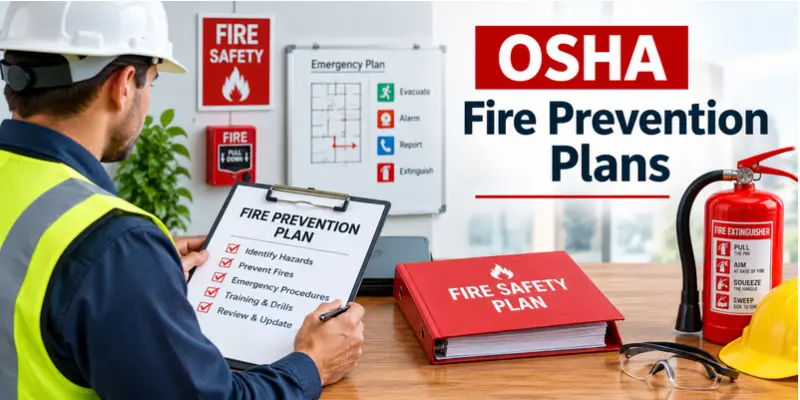
Under 29 CFR 1910.39, an employer must have a fire prevention plan when an applicable OSHA standard requires one. The plan must address the relevant fire hazards and the procedures used to prevent fires.
Required elements include major fire hazards, safe handling and storage procedures for hazardous materials, potential ignition sources and their control, necessary fire protection equipment, combustible waste management, and maintenance of safeguards on heat-producing equipment.
The plan must also identify the employees or job titles responsible for maintaining relevant equipment and controlling ignition and fuel-source hazards.
Employers must inform employees about the fire hazards to which they may be exposed and explain the applicable parts of the plan. OSHA permits an employer with 10 or fewer employees to communicate the plan orally rather than maintain a written version, under the conditions specified by the standard.
The exact provisions are available in the OSHA fire prevention plan standard.
For practical implementation, employers should identify potential ignition sources, control combustible waste, maintain heat-producing equipment, and assign clear responsibility for corrective action.
Emergency Action Plans and Evacuation Procedures
OSHA’s emergency action plan standard, 29 CFR 1910.38, establishes requirements when an OSHA standard requires an emergency action plan. The minimum elements include procedures for reporting fires and other emergencies, evacuation procedures, exit route assignments, and arrangements for accounting for employees after evacuation.
Depending on the applicable provisions, plans may also need to address rescue or medical duties, designated contacts, alarm systems, employee training, and review procedures.
Employers can consult the OSHA emergency action plan requirements for the complete provisions.
In practical terms, employees should understand how to report a fire, recognize alarms, use designated escape routes, and proceed to the appropriate assembly location. Evacuation arrangements should reflect the actual building layout and hazards.
Organizations should also consider visitors, contractors, and people who may need assistance evacuating. Training and periodic reviews can help identify weaknesses before an emergency occurs.
Exit Routes and Fire Protection Equipment
OSHA’s exit route requirements address the design, construction, maintenance, and safe operation of routes used by employees to leave a workplace. Relevant provisions cover exit capacity, access, markings, lighting, maintenance, and other operational features.
The applicable requirements are available through OSHA’s exit routes and emergency planning standards.
Fire extinguishers and other protection equipment must be selected and maintained according to the applicable standards and hazards. Equipment should remain accessible and suitable for the fires it is intended to address.
Employees should only attempt to extinguish a small, manageable fire when they have appropriate training, suitable equipment, and a clear escape route. They should evacuate when conditions are unsafe or a fire is spreading.
Our guide to fire extinguisher maintenance explains why routine inspection, servicing, and proper recordkeeping matter. Equipment maintenance should follow applicable regulations, relevant standards, and manufacturer instructions.
State and Local Fire Codes in the US
OSHA is not the only source of fire safety obligations in the United States. State and local authorities may enforce building codes, fire prevention codes, occupancy requirements, and provisions governing fire protection systems.
NFPA publications and International Code Council model codes may be incorporated into applicable local requirements. The adopted edition and local amendments matter because requirements can differ between jurisdictions.
For example, a warehouse storing combustible materials may have different fire protection requirements from a small office or a healthcare facility. Building height, storage arrangements, occupancy, and hazardous processes can all affect the applicable provisions.
Businesses should confirm requirements with the relevant fire marshal, building department, occupational safety authority, or other authority having jurisdiction before making compliance decisions.
Fire Safety Regulations in India
India’s fire safety framework includes national building guidance, state legislation, local building bylaws, and requirements administered by relevant authorities. The exact obligations depend on the building type, location, occupancy, and applicable legal instruments.
The Bureau of Indian Standards publishes the National Building Code of India 2016, which includes Part 4, Fire and Life Safety. This part addresses fire prevention, life safety, and fire protection, including matters such as occupancy classification, escape routes, and firefighting installations.
The National Building Code serves as a model code. Its legal application depends on the relevant laws, rules, and local provisions. Readers should not assume that every provision applies automatically in the same way in every state or municipality.
Depending on the building and location, requirements may concern fire safety approvals, access for firefighting operations, emergency exits, alarm and detection systems, firefighting equipment, evacuation arrangements, and maintenance of installed systems.
Owners and facility managers should check current requirements with the appropriate local fire service, building authority, and other relevant regulators. They should verify whether their premises require a fire safety certificate, no-objection certificate, inspection, or other approval under the applicable rules.
The BIS guide to using the National Building Code provides additional information about the code’s fire and life safety provisions.
India’s framework illustrates why fire safety requirements must be checked locally. Requirements applicable to a particular building in India should not be presented as universal rules for the United States or other countries.
International Fire Safety Codes and Standards
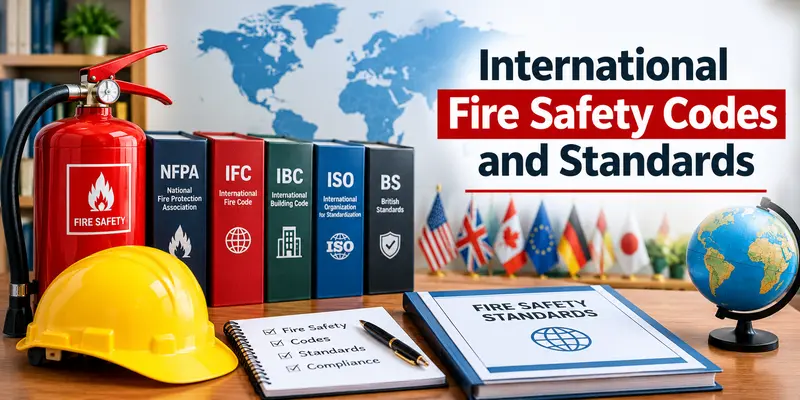
Countries use different combinations of national laws, building regulations, fire codes, and technical standards. Some rely on national building codes, while others give substantial authority to regional or municipal regulators.
The NFPA develops technical publications covering fire prevention, life safety, fire protection systems, and related subjects. For example, NFPA 10 addresses portable fire extinguishers, while NFPA 72 addresses fire alarm and signaling systems.
However, an NFPA publication does not automatically become legally mandatory everywhere. Its legal effect depends on whether the relevant authority has adopted or referenced it, which edition applies, and whether local amendments exist.
The NFPA codes and standards directory is a useful starting point for identifying publications relevant to a particular fire safety issue.
International businesses should maintain a location-specific compliance register identifying applicable laws, adopted code editions, required permits, inspection schedules, responsible personnel, and records that must be retained.
A multinational organization may establish one internal fire safety policy for all its facilities, but that policy should provide a common baseline rather than replace local legal requirements. Where a jurisdiction requires additional precautions, the organization must address those requirements separately.
Fire Extinguishers, Alarms, and Sprinkler Systems
Fire protection equipment is an important part of preventing small incidents from developing into serious emergencies. Equipment requirements depend on the building, its occupants, the hazards present, and the applicable codes.
Portable fire extinguishers should be suitable for the types of fires that could occur in a particular area. Different extinguishing agents are designed for different hazards, and using an unsuitable extinguisher can be ineffective or dangerous.
Extinguishers should be located appropriately, remain accessible, and receive inspection, testing, and maintenance as required by applicable standards and manufacturer instructions.
Fire alarms and detection systems provide warning that can help occupants evacuate promptly. Depending on the building, systems may include smoke detectors, heat detectors, manual call points, audible alarms, visual signals, and connections to other building systems.
Our guides to fire detectors and fire alarm systems explain the role of detection and warning equipment in fire protection.
Automatic sprinklers and other suppression systems may be required in certain buildings or hazardous areas. Their design should reflect the applicable code, occupancy, fire risks, water supply, and engineering requirements. Installation and maintenance should be performed by appropriately qualified professionals.
The NFPA fire alarm codes and standards guide provides further background on the relationship between fire codes and technical standards.
Buying fire extinguishers alone does not make a building compliant. Effective protection also depends on correct equipment selection, suitable installation, clear escape routes, employee awareness, and compliance with applicable inspection and maintenance requirements.
Emergency Exits, Evacuation Planning, and Fire Drills
Emergency exits and evacuation arrangements are central elements of fire safety regulations because smoke and heat can make a familiar building dangerous within a short time.
Exit routes should be designed and maintained according to applicable building and workplace requirements. Doors, corridors, stairways, exit signs, and discharge areas must meet the relevant provisions. Routes should not be obstructed by packaging, furniture, deliveries, waste, or temporary equipment.
Emergency lighting and signs may be required to help occupants identify escape routes during power failures or other emergencies. The number, width, arrangement, and protection of exits depend on factors such as occupancy, travel distances, building design, and applicable codes.
An evacuation plan should identify escape routes, alternative routes where appropriate, assembly areas, alarm procedures, and responsibilities assigned to staff. It should also account for visitors and people who may need assistance evacuating.
Fire drills and other exercises can help staff understand the plan and reveal practical problems. Their frequency and documentation should follow applicable requirements and the building’s risk profile.
After an exercise, management should review any difficulties and correct identified deficiencies. An effective plan is more than a diagram displayed on a wall; it requires clear instructions, employee awareness, accessible routes, reliable alarms, and periodic review.
Employer Responsibilities and Fire Safety Inspections
Employers and building managers should identify the fire safety requirements applicable to their premises and establish a process for maintaining compliance. Responsibilities may be distributed among owners, employers, facility managers, contractors, fire safety officers, and specialist service providers.
A practical compliance process begins with reviewing the applicable legal requirements and conducting a fire risk assessment. The assessment should consider ignition sources, combustible materials, electrical hazards, heating equipment, storage practices, escape routes, and the needs of people who occupy the premises.
Organizations should then implement suitable controls and assign responsibility for maintaining them. These controls may include housekeeping procedures, safe storage arrangements, hot-work controls, equipment maintenance, alarm testing, employee training, and evacuation planning.
Inspections should be carried out at the intervals required by applicable laws, codes, standards, and equipment instructions. Records of inspections, defects, corrective actions, maintenance, training, and approvals should be retained where required.
When an inspection identifies a blocked exit, defective alarm, damaged extinguisher, or other serious deficiency, the responsible person should arrange prompt corrective action. Critical issues should not be left unresolved until the next scheduled inspection.
Businesses should also review their fire safety arrangements after incidents, building modifications, changes in occupancy, new equipment installations, or changes in the materials handled on site.
Common Fire Safety Compliance Mistakes
Even organizations with fire protection equipment can have serious compliance gaps. One common mistake is assuming that extinguishers, alarms, or sprinklers automatically mean a building meets every legal requirement. Compliance depends on whether the correct systems are provided, installed, maintained, and operated as required.
Another mistake is treating evacuation routes as storage space. Corridors and exits can become obstructed by packaging, furniture, deliveries, or equipment, reducing occupants’ ability to escape.
Poor housekeeping is another concern. Accumulated combustible waste, improperly stored flammable liquids, and uncontrolled ignition sources can increase fire risk. Businesses should establish clear storage and waste management procedures and check that employees follow them.
Some organizations neglect employee training. Workers may not know how to report a fire, recognize alarms, locate assembly points, or respond to evacuation instructions. Training should be appropriate to the hazards and each employee’s responsibilities.
Finally, organizations may rely on outdated guidance or assume that a standard used in one country applies automatically elsewhere. Fire codes can be revised, local authorities can adopt different editions, and specific buildings may have additional obligations.
Regular reviews, suitable records, competent advice, and prompt corrective action help prevent these mistakes from undermining fire safety.
How to Maintain Fire Safety Compliance
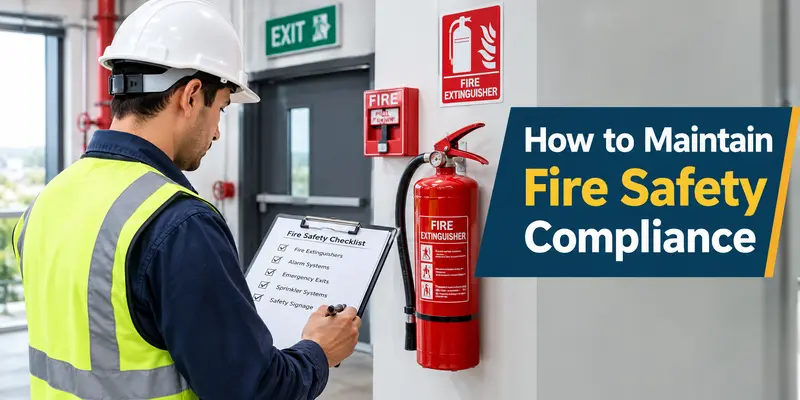
Maintaining compliance requires a systematic approach rather than a single inspection or equipment purchase.
First, identify the laws, codes, standards, permits, and approvals applicable to the building and its activities. Confirm the relevant editions and local amendments with the appropriate authority.
Second, document fire hazards and the measures used to control them. These may include electrical safety controls, safe storage, fire protection equipment, emergency procedures, and arrangements for vulnerable occupants.
Third, assign responsibility for routine checks, maintenance, staff training, and recordkeeping. Employees should understand their responsibilities, while specialist tasks should be handled by qualified personnel.
Fourth, investigate defects and close corrective actions promptly. Equipment that is out of service, an obstructed exit, or a malfunctioning alarm can create a serious safety concern.
Fifth, review compliance when operations or premises change. A new production process, altered storage layout, renovation, additional occupancy, or change in hazardous materials may affect fire safety requirements.
Finally, maintain communication with the relevant authorities and qualified fire safety professionals. Where legal interpretation or building design is involved, professional advice can help ensure that the selected controls meet the applicable requirements.
Frequently Asked Questions About Fire Safety Regulations
What are fire safety regulations?
Fire safety regulations are legal requirements and adopted provisions designed to prevent fires, protect occupants, and reduce property damage. They may cover building design, alarms, extinguishers, emergency exits, hazardous materials, evacuation plans, inspections, and maintenance.
Are fire safety regulations the same in every country?
No. Countries and local jurisdictions have different laws, codes, standards, and enforcement arrangements. Organizations should identify the requirements applicable to their location, building, occupancy, and activities.
What are the main fire safety requirements in the United States?
Relevant requirements may include OSHA workplace standards, adopted building and fire codes, suitable fire protection systems, safe exit routes, and emergency planning. The exact obligations depend on the workplace and applicable federal, state, and local requirements.
What is the National Building Code of India?
The National Building Code of India 2016 is published by the Bureau of Indian Standards. Part 4 addresses Fire and Life Safety, including fire prevention, evacuation, and fire protection provisions. Applicable state and local requirements must also be considered.
Are NFPA standards legally mandatory?
Not automatically everywhere. NFPA develops codes and standards that may be adopted or referenced by relevant authorities. Their legal applicability depends on the jurisdiction, adopted edition, and applicable legislation.
How often should fire safety equipment be inspected?
Inspection, testing, and maintenance intervals depend on the equipment type, applicable codes and standards, manufacturer instructions, and local requirements. Businesses should establish a documented schedule that meets the requirements relevant to their premises.
Who is responsible for workplace fire safety?
Responsibility depends on applicable law and organizational arrangements. Employers, building owners, facility managers, and other designated persons may have specific duties. Employees also need to follow established safety procedures and report hazards.
What should a business do if its fire safety arrangements are inadequate?
It should assess the hazards, identify applicable requirements, prioritize immediate risks, and arrange corrective action. Serious deficiencies involving evacuation routes, alarms, or essential fire protection equipment should be addressed promptly, with qualified professional assistance where necessary.
Conclusion
Fire safety regulations provide an essential framework for preventing fires, protecting people, and reducing damage to property and business operations. Their requirements can cover building design, fire prevention, detection and suppression systems, emergency exits, evacuation planning, employee training, inspections, and maintenance.
For US workplaces, OSHA standards provide important requirements concerning fire prevention plans, emergency action plans, and exit routes where applicable. In India, the National Building Code and relevant state and local requirements help shape building fire safety obligations. Other countries have their own regulatory frameworks, and technical standards such as those developed by NFPA apply according to the relevant adoption and legal arrangements.
The most effective approach is to combine general fire prevention principles with a clear understanding of local requirements. By identifying hazards, maintaining equipment, training occupants, keeping escape routes clear, and reviewing compliance regularly, organizations can improve preparedness and create safer workplaces and buildings.
For further reading, explore our guides to fire detectors, fire alarm systems, and fire extinguisher maintenance. These resources complement the regulatory guidance discussed in this article and help readers understand the practical role of fire protection equipment.
Please Write Your Comments