Food Safety Legislation: US Laws, Regulations, and Compliance Guide
Updated: 30-Oct-2026
40
Food safety legislation plays a critical role in protecting consumers, preventing foodborne illnesses, and ensuring that food businesses follow appropriate safety standards. In the United States, food safety laws and regulations establish requirements for producing, processing, packaging, labeling, transporting, storing, and selling food. These requirements apply differently depending on the type of food, the activities a business performs, and the federal, state, or local authorities responsible for oversight.
For food manufacturers, restaurants, grocery stores, food importers, distributors, and other businesses, understanding food safety legislation is essential for maintaining compliance and protecting public health. Federal laws establish many of the main requirements, while state and local regulations address additional responsibilities, particularly for retail food establishments.
The US food safety system includes several agencies, including the Food and Drug Administration (FDA), the United States Department of Agriculture (USDA), and state and local health departments. Each has a particular role in preventing contamination, inspecting food operations, enforcing applicable rules, and responding to potential food safety threats.
This guide explains the major US food safety laws, the role of regulatory agencies, the Food Safety Modernization Act (FSMA), common compliance requirements, and practical steps businesses can take to manage food safety risks.
What Is Food Safety Legislation?
Food safety legislation refers to the laws, regulations, and legally enforceable requirements designed to protect food from contamination and ensure that it is safe and properly represented to consumers. These rules cover different stages of the food supply chain, from agricultural production and manufacturing to transportation, retail distribution, and final sale.
In the United States, food safety legislation is not contained in a single law. Instead, it consists of several federal statutes, implementing regulations, and state and local requirements. The applicable rules depend on the product involved and the activities performed by the business.
For example, a food manufacturing facility may need to follow FDA requirements for preventive controls, sanitation, and facility registration where applicable. A meat processing establishment may fall under USDA Food Safety and Inspection Service (FSIS) oversight. Meanwhile, a restaurant generally needs to comply with its state and local food establishment requirements.
The distinction between legislation and guidance is also important. A statute establishes legal authority and requirements, while regulations explain how certain legal provisions are implemented. Guidance documents help businesses understand regulatory expectations, but guidance does not automatically have the same legal status as a binding regulation.
Businesses should therefore consult the relevant official sources rather than relying exclusively on general food safety articles. For a broader explanation of safety-related rules across industries, readers can also explore What Is Safety Regulation?.
Why Are Food Regulations Important?
Food regulations help prevent unsafe food from reaching consumers. Contamination can occur during farming, processing, packaging, storage, transportation, or preparation. Harmful microorganisms, undeclared allergens, chemical contaminants, and physical hazards can create serious risks when appropriate controls are missing.
The scale of the problem demonstrates why food safety regulations matter. The Centers for Disease Control and Prevention (CDC) estimates that approximately 48 million people in the United States experience foodborne illness each year. Its estimates also include about 128,000 hospitalizations and 3,000 deaths annually. These figures illustrate the public health importance of effective food safety controls. See the CDC’s Facts About Food Poisoning.
Food safety regulations are important for several reasons.
Protecting public health: Requirements for sanitation, temperature control, allergen management, and contamination prevention reduce the likelihood that consumers will be exposed to unsafe food.
Establishing consistent standards: Regulations define expectations for businesses and help regulators assess whether food operations meet applicable requirements.
Improving accountability: Documentation, inspections, traceability, and corrective actions help businesses identify problems and demonstrate how they manage food safety risks.
Supporting accurate labeling: Labeling requirements help consumers understand product identity, ingredients, and applicable allergen information.
Reducing business risks: Strong food safety systems can help prevent recalls, product losses, enforcement actions, legal disputes, and reputational damage.
Supporting confidence in the food supply: Consumers and commercial buyers are more likely to trust businesses that can demonstrate responsible food safety practices.
However, following a general checklist is not enough by itself. Businesses must identify which laws and regulations apply to their specific products, facilities, and activities.
Who Regulates Food Safety in the United States?
Food safety regulation in the United States is shared across several federal agencies and state and local authorities. Their responsibilities overlap in some areas, but they are not interchangeable. Understanding which agency regulates a particular product or activity is an essential first step toward compliance.
Food and Drug Administration (FDA)
The FDA regulates most domestic and imported food products, including many processed foods, packaged foods, seafood, produce, and food ingredients. It also administers important food safety requirements under the Federal Food, Drug, and Cosmetic Act and implements major provisions of the Food Safety Modernization Act.
Depending on the business and product, FDA responsibilities may include facility registration, food safety plans, preventive controls, food labeling, food imports, and responses to contamination risks.
Businesses can consult the FDA’s official Food Safety Modernization Act (FSMA) page for information about applicable rules and programs.
United States Department of Agriculture (USDA)
The USDA’s Food Safety and Inspection Service regulates covered meat, poultry, and processed egg products under federal inspection laws. Its responsibilities include inspection, food safety verification, and labeling oversight for products within its jurisdiction.
The exact division of responsibility depends on the product and its processing. Certain products containing meat or poultry may require careful jurisdictional review, so businesses should not assume that all packaged food is regulated by the same agency.
The USDA provides an overview of its responsibilities in its official explanation of meat and poultry inspection.
Centers for Disease Control and Prevention (CDC)
The CDC monitors foodborne illnesses, investigates outbreaks with public health partners, and provides information about foodborne pathogens and prevention. It plays an important role in identifying patterns of illness and helping authorities respond to outbreaks.
The CDC’s work supports food safety policy, but it is not the primary agency responsible for regulating every food facility.
Environmental Protection Agency (EPA)
The EPA regulates pesticides and establishes certain environmental and public health standards relevant to food safety. For example, pesticide residue limits on food are established under applicable federal law, with the EPA playing a central role in setting tolerances.
Other agencies are responsible for enforcing relevant food requirements within their jurisdictions. Businesses should consult the appropriate official sources when pesticide residues, water quality, or environmental contaminants are relevant to their operations.
State and Local Health Departments
State, county, and municipal authorities commonly oversee restaurants, grocery stores, food service operations, mobile food businesses, and other retail establishments. Their responsibilities may include issuing permits, inspecting facilities, enforcing local sanitation rules, and responding to complaints.
Requirements can vary by location. Therefore, a restaurant or retail food business should check the rules of the jurisdiction where it operates rather than assuming that federal requirements cover every operational detail.
Major US Food Safety Laws and Regulations
US food safety legislation consists of several laws that address different food categories, hazards, and stages of production. The following are among the most important legal frameworks for understanding food safety responsibilities.
Federal Food, Drug, and Cosmetic Act (FD&C Act)
The Federal Food, Drug, and Cosmetic Act is a central federal law governing the safety and labeling of many foods regulated by the FDA. It provides legal authority for addressing adulterated or misbranded food and supports various FDA food safety requirements.
Food may be considered adulterated under applicable provisions for reasons such as contamination, insanitary production conditions, or other violations defined by law. Misbranding concerns can arise when labeling is false, misleading, or otherwise fails to meet applicable requirements.
The Act also provides a legal foundation for important preventive controls and other food safety regulations. Businesses can review the FDA’s food guidance and regulation resources to identify requirements relevant to their products and activities.
Food Safety Modernization Act (FSMA)
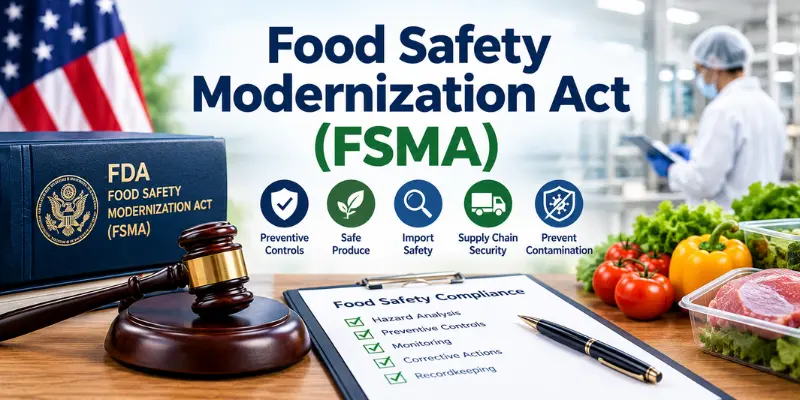
The Food Safety Modernization Act, signed into law in 2011, represents a major shift toward preventing food safety problems rather than relying primarily on responding after contamination occurs.
FSMA authorized the FDA to establish a number of rules addressing preventive controls, produce safety, imported food, sanitary transportation, intentional adulteration, and other areas. These rules apply differently depending on the food, facility, activity, and any applicable exemptions or modified requirements.
For businesses covered by the relevant rules, FSMA compliance may involve identifying hazards, implementing preventive controls, maintaining records, evaluating suppliers, and establishing corrective action procedures.
The FDA provides the official overview of FSMA rules and programs.
Federal Meat Inspection Act (FMIA)
The Federal Meat Inspection Act establishes federal inspection and related requirements for covered meat products. It is a key part of the legal framework administered by USDA FSIS.
Businesses that slaughter, process, or distribute regulated meat products must determine which inspection, sanitation, labeling, and other requirements apply to their operations. Requirements may differ based on the type of establishment, the product, and whether state or federal inspection arrangements apply.
Poultry Products Inspection Act (PPIA)
The Poultry Products Inspection Act provides the legal framework for inspection and regulation of covered poultry products. It supports requirements intended to ensure that poultry products entering commerce meet applicable safety and labeling standards.
Poultry processors should establish procedures that address contamination prevention, sanitary handling, process controls, and inspection-related obligations. The exact requirements depend on the operation and applicable regulations.
Egg Products Inspection Act
The Egg Products Inspection Act establishes requirements for covered egg products, including federal inspection provisions. It is relevant to businesses processing or handling regulated egg products and forms part of the broader USDA food safety framework.
Businesses should distinguish shell eggs from processed egg products because different regulatory requirements may apply. They should confirm their obligations with USDA FSIS and the relevant state authorities.
Public Health Service Act and Other Relevant Requirements
Other federal laws and regulations contribute to food safety, public health protection, environmental controls, and specific product requirements. Depending on the business, relevant rules may concern drinking water, pesticides, food contact materials, packaging, imports, or specialized food categories.
Because these requirements can change and may interact, businesses should identify the rules that apply to their exact products and processes rather than relying on a single general list.
What Is the Food Safety Modernization Act (FSMA)?
The Food Safety Modernization Act is one of the most important components of modern US food safety legislation. Its central purpose is to strengthen prevention across the food supply chain.
Before the development of FSMA’s preventive framework, food safety programs often emphasized identifying and responding to problems after they occurred. FSMA expanded the focus on identifying hazards in advance and implementing controls designed to reduce the likelihood of contamination.
FSMA is not a single checklist that applies identically to every food business. Instead, it includes multiple rules and programs, each addressing particular risks or activities.
Major FSMA-related rules include the following:
Preventive Controls for Human Food: Covered facilities generally need to evaluate food safety hazards and establish a written food safety plan that includes hazard analysis and risk-based preventive controls, subject to applicable exemptions and modified requirements.
Produce Safety Rule: Establishes science-based minimum standards for the safe growing, harvesting, packing, and holding of certain produce.
Foreign Supplier Verification Programs (FSVP): Requires covered importers to perform risk-based activities to verify that imported food meets applicable US food safety requirements.
Sanitary Transportation: Addresses practices intended to prevent food safety risks during transportation, where the rule applies.
Intentional Adulteration: Establishes requirements for certain facilities to address vulnerabilities to intentional acts intended to cause wide-scale public health harm.
Food Traceability Rule: Establishes additional recordkeeping requirements for certain foods on the Food Traceability List, subject to the rule’s scope and applicable provisions.
The requirements, exemptions, compliance dates, and implementation details vary across rules. Businesses should use the FDA’s official FSMA materials to confirm the requirements that currently apply to their operations.
FSMA Compliance Requirements for Food Businesses
FSMA compliance depends on the nature of the business and which rules apply. A covered food manufacturing facility, for example, may have different obligations from a farm, an importer, a transporter, or a retail food establishment.
For facilities covered by the Preventive Controls for Human Food rule, a written food safety plan is generally required. The plan is developed and overseen by a qualified individual as specified by the applicable requirements.
Hazard Analysis
Hazard analysis identifies known or reasonably foreseeable biological, chemical, and physical hazards associated with a food and its production process. Examples may include pathogens, undeclared allergens, chemical contamination, and foreign objects.
The analysis should consider how hazards could arise during processing, storage, handling, packaging, or other activities. Businesses should document their assessment in the form required by the applicable rule.
Preventive Controls
Where hazard analysis identifies hazards requiring preventive controls, covered facilities must establish appropriate written controls. Depending on the hazard, controls may involve processing steps, sanitation, allergen management, supply chain activities, or other measures.
For example, a process may require specified temperature parameters, while an allergen control program may need procedures to prevent cross-contact and ensure appropriate labeling.
Monitoring and Corrective Actions
Businesses need procedures to determine whether required controls are being implemented. Monitoring methods and frequencies depend on the control and the applicable requirements.
When a problem occurs, corrective actions may be necessary to correct the issue, evaluate affected food, reduce the likelihood of recurrence, and prevent unsafe food from entering commerce. Required actions and records should be maintained according to the applicable rule.
Verification and Documentation
Verification activities help determine whether food safety controls are implemented consistently and are effective. Depending on the circumstances, they may include reviewing records, calibrating instruments, validating process controls, testing products, or conducting environmental monitoring.
Documentation is not merely administrative work. Proper records help demonstrate how a business identified hazards, implemented controls, and responded to problems.
For detailed requirements, consult the FDA’s official Preventive Controls for Human Food rule.
Food Safety Standards for Manufacturing, Packaging, and Labeling
Food manufacturing and packaging operations must follow requirements relevant to the products they produce and the processes they use. Applicable rules may address sanitation, employee hygiene, facility design, equipment maintenance, ingredient handling, allergen control, and production procedures.
FDA Current Good Manufacturing Practice requirements are important for many food facilities. They address the conditions and practices needed to produce safe food, including sanitary operations and appropriate employee practices. The specific requirements depend on the facility and applicable regulations.
Businesses can review the FDA’s information on Current Good Manufacturing Practices for Food.
Packaging and labeling also play an important role. Food labels must meet applicable requirements concerning product identity, ingredients, allergen declarations, and other information where required. Businesses should ensure that packaging protects food appropriately and does not create contamination risks.
A food package may be physically intact but still fail to meet legal requirements if its label is inaccurate or omits required information. Similarly, correct labeling cannot compensate for unsafe manufacturing conditions.
For workers handling food or packaging materials, suitable protective equipment and hygiene practices may form part of an overall safety program. Businesses can also review Food Processing and Packaging PPE for related workplace protection considerations. PPE supports worker protection but does not replace required food sanitation and contamination controls.
Food Safety Rules for Restaurants and Retail Businesses
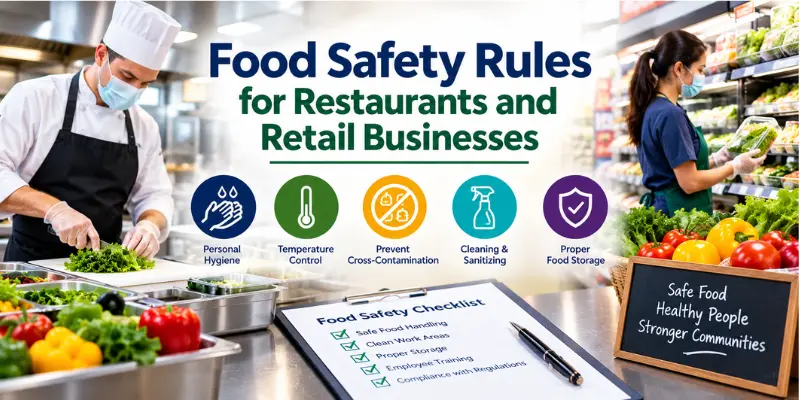
Restaurants, grocery stores, cafeterias, food trucks, and other retail food operations must comply with the applicable state and local requirements, as well as any relevant federal provisions.
The FDA publishes the Food Code as a model for jurisdictions developing or updating retail and food service food safety rules. The Food Code is not automatically a single nationwide law that applies identically everywhere. State, local, tribal, and territorial authorities decide how to adopt or adapt its provisions under their legal frameworks.
The FDA issued the 2026 Food Code in September 2026. Businesses and regulators should check the applicable local code and adoption status rather than assume that every provision of the latest model edition has already become law in their jurisdiction. See the official FDA Food Code and the FDA’s state retail and food service codes and regulations directory.
Common areas covered by retail food safety rules include:
- Employee health and personal hygiene.
- Handwashing and prevention of cross-contamination.
- Safe cooking, cooling, reheating, and holding temperatures.
- Proper refrigeration and food storage.
- Cleaning and sanitizing food-contact surfaces.
- Protection of food from pests and environmental contamination.
- Safe handling of raw and ready-to-eat foods.
- Food source, labeling, and allergen-related requirements where applicable.
The exact requirements vary by jurisdiction and business type. A restaurant should confirm its permit conditions, inspection requirements, and local food code with the relevant health department.
For practical food handling information, businesses may also consult the USDA’s Steps to Keep Food Safe. These consumer-oriented practices can support safe operations, but they do not replace the legal requirements applicable to a food establishment.
Food Safety Legislation Requirements for Importers
Food importers have specific responsibilities under US food safety laws. Importing a product does not remove the need to meet applicable US requirements.
Depending on the product and the activities involved, importers may need to address FDA entry requirements, facility registration where applicable, prior notice, product labeling, and other regulatory conditions. Certain importers are also subject to the Foreign Supplier Verification Programs rule under FSMA.
Covered importers under FSVP generally must establish and follow risk-based procedures to verify that their foreign suppliers produce food in compliance with applicable US food safety requirements and that the food is not adulterated or misbranded with respect to applicable allergen labeling requirements.
The precise obligations depend on the importer, supplier, food, and any applicable exemptions or modified requirements. Meat, poultry, and certain egg products may fall under USDA FSIS import requirements instead of, or in addition to, other requirements.
Importers should maintain appropriate supplier documentation, product records, and verification information. They should also confirm current requirements with the relevant agency before shipping products to the United States.
Inspections, Violations, and Enforcement
Food safety authorities use inspections, records reviews, sampling, investigations, and other regulatory activities to assess compliance and respond to potential risks. The agency responsible depends on the product, facility, and legal authority involved.
An inspection may examine sanitation, employee practices, process controls, labeling, recordkeeping, and the handling of ingredients or finished products. Inspectors may also review whether a business has addressed earlier violations or implemented required corrective actions.
When regulators identify a problem, the response depends on the nature and seriousness of the issue, the applicable law, and the agency’s authority. Possible actions may include requesting corrective measures, detaining or refusing certain products, issuing warning letters, initiating recalls, suspending certain activities or registrations where legally authorized, or pursuing civil or criminal enforcement in appropriate cases.
Not every violation leads to the same penalty. Legal consequences depend on the facts, the statute or regulation involved, the responsible party, and the available enforcement provisions.
Businesses should not assume that a written food safety policy alone proves compliance. Procedures must be implemented in practice, employees must understand their responsibilities, and required records must be accurate and accessible.
When a business discovers potentially unsafe food, it should promptly assess the risk, stop distribution where appropriate, preserve relevant records, and seek qualified regulatory or legal advice about reporting, withdrawal, or recall obligations. Delaying action may increase public health and business risks.
How Businesses Can Maintain Food Safety Compliance
A structured compliance program helps a business translate legal requirements into daily operations. The right program depends on the food handled, the processes used, and the rules applicable to the facility.
Identify Applicable Laws and Regulators
Start by identifying the products you manufacture, store, transport, import, or sell. Determine whether the FDA, USDA FSIS, state agencies, local health departments, or multiple authorities have jurisdiction over your activities.
Then review the current laws and regulations that apply to each activity. Do not rely on assumptions based solely on a competitor’s practices or a generic online checklist.
Conduct a Risk Assessment
Identify potential biological, chemical, and physical hazards associated with your products and processes. Consider ingredients, suppliers, production equipment, packaging, storage, transportation, and intended use.
Where required, conduct and document the formal hazard analysis and preventive controls specified by the applicable regulation.
Establish Written Procedures
Develop clear procedures for sanitation, employee hygiene, allergen management, temperature control, supplier approval, traceability, and corrective actions as relevant to your operations.
Assign responsibility for each task and establish a process for reviewing and updating procedures when products, equipment, suppliers, or regulations change.
Train Employees
Employees should understand the food safety practices relevant to their duties. Training may cover handwashing, cleaning and sanitizing, safe food handling, allergen awareness, contamination prevention, and recordkeeping.
Training should be appropriate to each employee’s responsibilities and comply with any applicable legal requirements. Managers should verify that employees can follow procedures consistently in actual working conditions.
Maintain Records
Keep the records required by the applicable rules and maintain other documentation needed to manage your food safety system. Depending on the operation, records may include supplier approvals, temperature logs, sanitation checks, training records, corrective actions, and traceability information.
Records should be accurate, organized, and available when needed for internal reviews or regulatory inspections.
Review and Improve the Program
Review incidents, customer complaints, inspection findings, supplier performance, and changes in regulations to identify opportunities for improvement.
When a food safety problem occurs, investigate its cause and take appropriate action to prevent recurrence. A functioning compliance program should be updated as risks and legal requirements evolve.
Businesses should also consider the workplace hazards employees face while performing these tasks. Related protective measures are discussed in Food Industry PPE, although PPE requirements and food safety controls address different risks and should be assessed separately.
Frequently Asked Questions About Food Safety Legislation
What is the main purpose of food safety legislation?
The main purpose of food safety legislation is to protect public health by reducing contamination risks and establishing requirements for producing, processing, transporting, labeling, and selling food. It also helps define business responsibilities and gives regulatory authorities legal mechanisms to address violations.
What are the main food safety laws in the United States?
Important laws include the Federal Food, Drug, and Cosmetic Act, the Food Safety Modernization Act, the Federal Meat Inspection Act, the Poultry Products Inspection Act, and the Egg Products Inspection Act. Additional federal, state, and local requirements may apply depending on the product and activity.
What does FSMA mean?
FSMA stands for the Food Safety Modernization Act. It strengthened the FDA’s preventive approach to food safety through rules and programs covering areas such as preventive controls, produce safety, imported food, sanitary transportation, and intentional adulteration.
Who enforces food safety regulations in the US?
Responsibilities are shared among federal agencies and state and local authorities. The FDA regulates many food products, USDA FSIS regulates covered meat, poultry, and processed egg products, and state or local agencies commonly oversee restaurants and retail food establishments.
Are FDA Food Code provisions mandatory in every state?
No. The FDA Food Code is a model used by jurisdictions to develop or update retail and food service food safety rules. Its provisions become enforceable through applicable adoption and legal processes. Businesses must check the rules in their own jurisdiction.
What happens if a food business violates food safety regulations?
Consequences depend on the violation, the applicable law, and the circumstances. Possible outcomes include corrective actions, product detention, recalls, warning letters, restrictions on operations, civil penalties, or criminal enforcement where authorized. Businesses should consult the responsible agency and qualified legal counsel when necessary.
How can a food business check which laws apply to it?
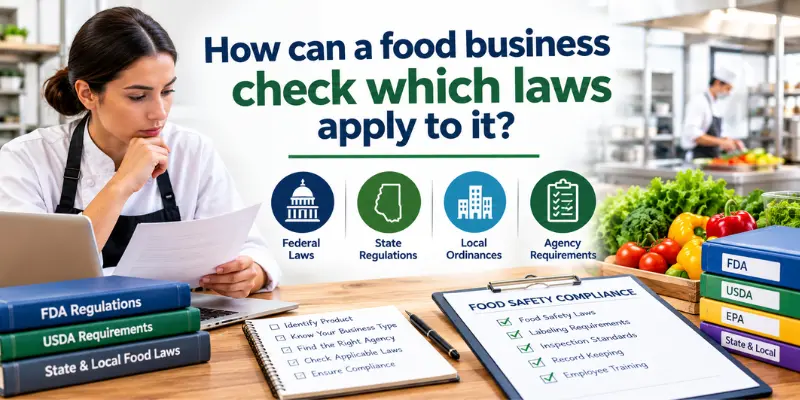
Identify the products and activities involved, determine which agencies have jurisdiction, and consult current official federal, state, and local resources. Businesses should review applicable regulations and agency guidance, document their compliance process, and seek qualified professional advice when requirements are unclear.
Conclusion
Food safety legislation provides the legal foundation for protecting consumers and managing risks throughout the US food supply chain. Federal laws establish important requirements for food safety, preventive controls, inspection, labeling, and imports, while state and local authorities play a major role in regulating retail food establishments.
For businesses, compliance starts with understanding which laws apply to their products and activities. They must then implement suitable procedures, train employees, maintain required records, and respond promptly when problems arise.
The Food Safety Modernization Act is a major part of this framework, but it is not the only relevant law. The FDA, USDA FSIS, and state and local authorities have different responsibilities, and businesses should consult the appropriate official sources for current requirements.
Ultimately, an effective food safety program is more than a paperwork exercise. It combines legal awareness, preventive controls, employee training, sound operational practices, and continuous improvement to help keep food safe and protect public confidence.
Please Write Your Comments