Food Safety and Standards Act, 2006: Key Sections, Rules, and Penalties
Updated: 29-Oct-2026
41
The Food Safety and Standards Act, 2006 is one of India’s most important laws for protecting public health through safe food production, distribution, storage, and sale. It established a unified legal framework for food safety and provided the foundation for the Food Safety and Standards Authority of India (FSSAI). The law applies to a wide range of food-related activities, making it relevant to manufacturers, processors, importers, distributors, retailers, restaurants, and other food business operators.
Before this Act, food-related requirements were spread across different laws and regulatory systems. Bringing these provisions together helped create a more consistent approach to food standards, enforcement, and consumer protection. However, understanding the Act requires more than knowing what FSSAI does. Businesses also need to understand their legal responsibilities, the significance of important sections, and the consequences of selling unsafe or non-compliant food.
In this guide, we explain the Food Safety and Standards Act, 2006, in straightforward language, including its objectives, important provisions, offences, penalties, and practical implications for food businesses.
For a broader overview of the authority and its regulatory responsibilities, readers can also explore our guide to Food Safety and Standards Authority: Roles, Regulations, and Global Guide.
What Is the Food Safety and Standards Act, 2006?
The Food Safety and Standards Act, 2006, is an Indian Act of Parliament designed to consolidate laws relating to food and establish science-based standards for food products. It received presidential assent on August 23, 2006, and is officially identified as Act No. 34 of 2006.
Its central purpose is to help ensure that food intended for human consumption is safe and wholesome. To achieve this, the Act provides a framework for regulating food manufacturing, processing, storage, distribution, sale, and import.
The legislation also established the Food Safety and Standards Authority of India, commonly known as FSSAI. The authority develops food standards and carries out responsibilities assigned to it under the law, while designated central and state authorities perform enforcement functions.
The original Act is available through the official FSSAI Act page. Reading the legislation itself is useful when a business needs to verify the wording of a particular section rather than rely on a general explanation.
It is important to understand that the Act is the primary legislation, while detailed requirements are also established through rules, regulations, amendments, and official notifications. Consequently, complying with the original text alone may not be sufficient if a later regulation applies to a particular food product or business activity.
Why Was the Food Safety and Standards Act Introduced?
The Act was introduced to create a more coordinated and science-based approach to food safety in India. A fragmented regulatory system can make it difficult for businesses to understand their obligations and for authorities to apply standards consistently.
The legislation aimed to address this challenge by establishing a central food authority and a common framework for food standards and enforcement.
Several important considerations explain why the law matters.
First, it supports consumer protection. Food can present serious health risks when it contains harmful contaminants, is improperly handled, or is manufactured in unsafe conditions. A consistent legal framework helps authorities address these risks.
Second, it promotes standardisation. Food products need to meet applicable requirements relating to composition, safety, additives, contaminants, and other regulated characteristics. Standards help businesses understand what they can legally manufacture and sell.
Third, it establishes accountability. Food business operators have responsibilities for the safety and compliance of products under their control. The law provides mechanisms for addressing violations and holding responsible parties accountable.
Finally, it supports more consistent enforcement. Designated authorities can inspect businesses, collect samples, investigate suspected violations, and take action under applicable provisions.
Together, these objectives help create a food system in which safety is treated as a legal responsibility rather than simply a voluntary business practice.
Main Objectives and Scope of the Act
The Food Safety and Standards Act, 2006, covers several connected areas of food regulation.
Establishing science-based food standards
The Act provides the framework for setting standards for articles of food. Depending on the product and applicable regulations, these standards may address composition, permitted additives, contaminants, residues, packaging, labelling, and other safety-related requirements.
Food businesses must identify the rules applicable to their particular products. A requirement that applies to one product category may not apply in exactly the same way to another.
Regulating food business activities
The law addresses food through multiple stages of the supply chain, including manufacturing, processing, storage, distribution, sale, and import. This broad scope is important because contamination can occur at different points between production and consumption.
Preventing unsafe and non-compliant food
The Act establishes responsibilities and enforcement mechanisms intended to prevent unsafe, misbranded, substandard, or otherwise non-compliant food from entering or remaining in the market.
Establishing a regulatory authority
FSSAI provides the central framework for food standards and other responsibilities assigned under the legislation. Enforcement also involves designated officers and authorities at different levels of government.
Protecting public health
The overall objective is to improve the safety of food available for human consumption. This includes preventing avoidable risks, supporting appropriate enforcement, and enabling corrective action when food fails to meet legal requirements.
Important Sections of the Food Safety and Standards Act, 2006
The Act contains provisions dealing with definitions, food standards, the food authority, business responsibilities, enforcement, offences, penalties, and legal proceedings. The following sections are particularly useful for understanding how the law operates.
Section 18: General principles to be followed in administration of the Act
Section 18 sets out general principles for administering the legislation. These principles guide the approach to food safety decisions and regulatory action.
They include considerations relating to public health, risk assessment, transparency, and the protection of consumers. Decisions involving food safety should be informed by relevant scientific evidence and the nature of the potential risk.
For businesses, this section helps explain why compliance is not limited to completing paperwork. Authorities must also consider the purpose of the law and the protection of public health when applying its provisions.
Section 23: Packaging and labelling of food
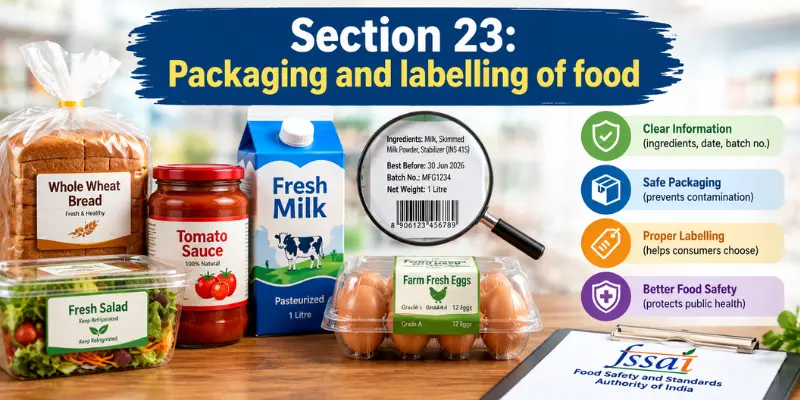
Section 23 addresses packaging and labelling requirements, subject to the applicable regulations. Food businesses must ensure that products are packaged and labelled in accordance with the legal requirements relevant to their category.
Depending on the product, applicable rules may govern declarations, product identity, ingredients, allergens, nutritional information, dates, and other mandatory particulars.
Incorrect declarations or misleading product information can create compliance problems even when the food itself is not visibly spoiled. Businesses should therefore review both the product and its label before placing it on the market.
The precise requirements should be checked against the relevant current regulations listed on the official FSSAI regulations page.
Section 26: Responsibilities of the food business operator
Section 26 is one of the most important provisions for businesses. It places responsibility on food business operators to ensure that food under their control meets the requirements of the Act and the rules and regulations made under it.
The section addresses responsibilities across stages such as production, processing, import, distribution, and sale. It also restricts dealing in certain categories of non-compliant food, including unsafe and misbranded products.
In practical terms, businesses should establish procedures to control food safety risks, check suppliers, maintain suitable storage conditions, monitor production processes, and respond appropriately when a product may be unsafe.
These responsibilities are relevant to manufacturers and distributors as well as retailers, restaurants, catering businesses, and other operators covered by the law.
Sections 27 and 28: Liability and food recall
Sections 27 and 28 address liability in specified circumstances and the recall of food. Their application depends on the facts, the relevant legal provisions, and the roles of the parties involved.
A recall can become necessary when food presents a safety risk or otherwise requires removal from the market under the applicable framework. An effective recall process may involve identifying affected batches, tracing distribution, notifying relevant parties, and preventing further sale.
Businesses benefit from maintaining accurate batch records and supplier information. Without reliable traceability, identifying affected products and responding quickly can become difficult.
Section 31: Licensing and registration
Section 31 establishes the licensing and registration framework for food businesses. In general, food business operators must obtain the applicable licence or registration unless a relevant legal exemption or special provision applies.
The licensing and registration requirements are developed further through the Food Safety and Standards (Licensing and Registration of Food Businesses) Regulations, 2011, as amended.
The appropriate authorisation depends on the nature and scale of the activity and the current rules applicable to the business. Operators should verify the latest eligibility criteria rather than rely on an old turnover threshold or an outdated online guide.
The official FSSAI licensing page provides information about licensing, while the registration page explains the registration framework.
Sections 32–42: Enforcement and related procedures
These provisions address enforcement mechanisms and related procedures, including improvement notices, prohibition orders, food safety officers, sampling, analysis, and other regulatory functions.
For example, an improvement notice may require an operator to correct specified failures. Depending on the circumstances and applicable legal requirements, further action may follow if the operator fails to comply.
Food safety officers and other designated authorities have powers under the legislation, but those powers must be exercised within the relevant legal framework.
Businesses should respond to official notices promptly, maintain records of corrective action, and seek qualified advice if they disagree with an enforcement decision.
Sections 48–58: Different offences and penalties
These sections address a range of food-related offences and penalties. The applicable provision depends on the nature of the violation, the evidence, the consequences, and any relevant amendments.
The provisions distinguish between different forms of non-compliance, including selling food that does not meet prescribed standards, misbranding, misleading advertisements, unhygienic processing, and dealing with unsafe food.
It is important not to treat every food safety violation as the same offence. The legal consequences for a labelling failure may differ significantly from those for food that causes serious injury.
Section 59: Punishment for unsafe food
Section 59 addresses punishment for unsafe food. The consequences depend in part on whether the offence results in no injury, non-grievous injury, grievous injury, or death.
The provision includes different levels of punishment, with more serious consequences where unsafe food causes greater harm. The applicable text and any amendments must be checked before quoting a specific punishment in a compliance decision.
This section demonstrates why businesses should not treat food safety as a minor administrative issue. Unsafe products can create serious risks for consumers and substantial legal exposure for those responsible.
The complete statutory wording can be reviewed through India Code’s Food Safety and Standards Act document.
Offences and Penalties Under the Act
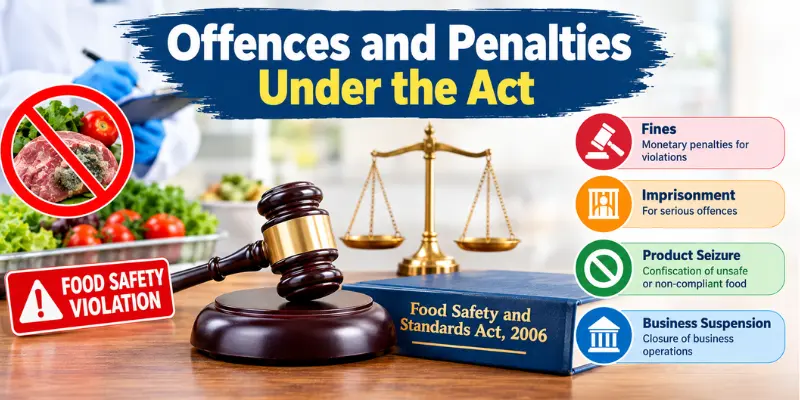
Offences and Penalties Under the Food Safety and Standards Act, 2006
The Food Safety and Standards Act, 2006, establishes different penalties for different types of food safety violations. The applicable consequence depends on the nature of the offence, the relevant statutory provision, the facts of the case, and any applicable amendments.
The following examples illustrate some important provisions:
| Section | Type of violation | Penalty or legal consequence |
|---|---|---|
| Section 50 | Selling food that does not meet the nature, substance, or quality demanded | Penalty may extend to ₹5 lakh, subject to the statutory proviso for certain small food business operators |
| Section 51 | Substandard food | Penalty may extend to ₹5 lakh |
| Section 52 | Misbranded food | Penalty may extend to ₹3 lakh |
| Section 53 | Misleading food advertisement | Penalty may extend to ₹10 lakh |
| Section 54 | Food containing extraneous matter | Penalty may extend to ₹1 lakh |
| Section 55 | Failure to comply with directions of a Food Safety Officer | Penalty may extend to ₹2 lakh |
| Section 56 | Unhygienic or unsanitary food processing or manufacturing | Penalty may extend to ₹1 lakh |
| Section 57 | Possessing an adulterant | The penalty depends on whether the adulterant is injurious to health |
| Section 58 | Contraventions for which no specific penalty is provided | Penalty may extend to ₹2 lakh |
| Section 59 | Unsafe food | Punishment depends on the circumstances and the resulting harm, including injury or death |
| Section 63 | Carrying on a food business without the required licence | Penalty may extend to ₹10 lakh, subject to the applicable statutory provisions |
These figures are statutory maximums for the listed provisions, not automatic fines in every case. The law provides different procedures and consequences depending on the offence. Section 59, in particular, must be read in its amended form because the punishment varies according to the consequences of the unsafe food.
Before relying on any figure for a compliance decision, check the current statutory text, commencement notifications, and applicable regulations. The official FSSAI Act and amendments page and the India Code version of the Act are useful starting points.
For a specific notice, alleged offence, or legal dispute, consult a qualified professional familiar with Indian food law.
For further official information, consult the FSSAI Act and amendments and the current regulations applicable to the product or activity.
How Is the Act Enforced?
Enforcement involves designated authorities operating within the legal framework established by the Act and its associated rules and regulations.
Depending on the circumstances, the process may involve inspection, sampling, laboratory analysis, investigation, notices, adjudication, or prosecution.
Inspection and sampling
Authorised food safety officers may inspect relevant premises and collect samples in accordance with applicable legal procedures. Laboratory analysis can help determine whether a sample meets the required standards or presents a safety concern.
Businesses should keep relevant product records, supplier documents, batch details, and applicable testing information organised and accessible.
Improvement and corrective action
Where a business fails to meet a requirement, an authority may take action under the relevant provisions. Depending on the issue, this may involve an improvement notice or another regulatory measure.
Operators should identify the underlying problem, implement corrective measures, and document what has changed. Repeated failures can increase operational and legal risks.
Adjudication and prosecution
Certain violations may be handled through adjudication, while more serious matters may proceed through the relevant criminal justice process. The appropriate route depends on the offence and the provisions that apply.
Businesses should not assume that every notice automatically results in prosecution, nor should they ignore a notice because they believe the problem is minor. Legal deadlines and procedural requirements can be important.
Food Safety Compliance: What Businesses Should Do
Understanding the law is only the first step. Food businesses also need practical systems that help them meet applicable requirements consistently.
Identify the rules that apply to your business
Start by identifying the products you handle, your role in the supply chain, and the activities performed at your premises. A manufacturer, importer, restaurant, warehouse, and retailer may have different compliance needs.
Check the relevant product standards, licensing requirements, labelling rules, hygiene requirements, and any sector-specific regulations.
Maintain appropriate hygiene and handling controls
Establish suitable procedures for cleaning, sanitation, pest control, temperature management, storage, and handling. Train employees to follow these procedures and review them when processes or risks change.
Where personal protective equipment is appropriate to the work, select it according to the actual hazards and applicable workplace requirements. Our guides to food processing and packaging PPE and food industry PPE provide additional context on protective equipment in food-related workplaces.
PPE is only one part of workplace risk control. It does not replace food hygiene, sanitation, suitable facilities, or compliance with the applicable food standards.
Keep accurate records
Maintain relevant records for suppliers, ingredients, batches, production activities, cleaning, training, complaints, testing, and corrective action. The exact records required depend on the business and the applicable regulations.
Good records can help a business investigate a complaint, identify affected products, demonstrate corrective action, and respond to an inspection.
Review labels and product claims
Before selling a product, check that its label and any marketing claims comply with the applicable rules. Claims should be accurate, supported where necessary, and not misleading.
Because labelling rules may change, businesses should periodically review official notifications rather than assuming that a previously approved label remains compliant indefinitely.
Prepare for complaints and recalls
Create a procedure for handling complaints about suspected contamination, undeclared allergens, spoilage, or other safety concerns. The procedure should explain who assesses the report, how affected batches are traced, and when escalation or a recall may be required.
Prompt action can reduce risks to consumers and help prevent a problem from spreading through the supply chain.
Amendments and Current Legal Status
FSSAI lists amendments to the Food Safety and Standards Act, 2006, including amendments enacted in 2008, 2011, and 2023. Some provisions have separate commencement notifications, so an amendment’s enactment date does not necessarily mean that every change took effect on the same date. For example, FSSAI lists an enforcement notification dated 7 November 2023 covering Sections 59(i), 61, and 63. Businesses should therefore verify the applicable commencement notification and current statutory wording before relying on a particular penalty or compliance requirement.
For the latest information, consult the official FSSAI Act amendments and Act enforcement notifications.
- FSSAI — Food Safety and Standards Act, 2006
- FSSAI — Act amendments
- FSSAI — Regulations and amendments
- India Code — Food Safety and Standards Act
These sources should be checked for the current legal position, including the commencement and effect of relevant amendments. If a question involves a pending notice, a disputed penalty, or a possible offence, seek advice from a qualified legal professional familiar with Indian food law.
Frequently Asked Questions
What is the Food Safety and Standards Act, 2006?
The Food Safety and Standards Act, 2006, is an Indian law that consolidates food-related legislation and establishes a framework for science-based food standards. It also established FSSAI and provides for the regulation of food manufacture, storage, distribution, sale, and import to help protect public health.
Why is the Food Safety and Standards Act important?
It provides a common legal framework for food safety, defines responsibilities for food businesses, supports standards for food products, and establishes enforcement mechanisms. It helps protect consumers and gives businesses a clearer structure for understanding their legal obligations.
What is the role of FSSAI under the Act?
FSSAI is the authority established under the Act. Its responsibilities include functions relating to food standards and other regulatory duties assigned by the legislation. Enforcement also involves designated central and state authorities and food safety officers.
Which section deals with food business operator responsibilities?
Section 26 addresses the responsibilities of food business operators. It concerns compliance with applicable food safety requirements and restrictions on dealing in certain non-compliant food products.
Which section deals with licensing and registration?
Section 31 provides the licensing and registration framework for food businesses. Detailed procedures and requirements are set out in the applicable licensing and registration regulations, including subsequent amendments.
What happens if a business sells unsafe food?
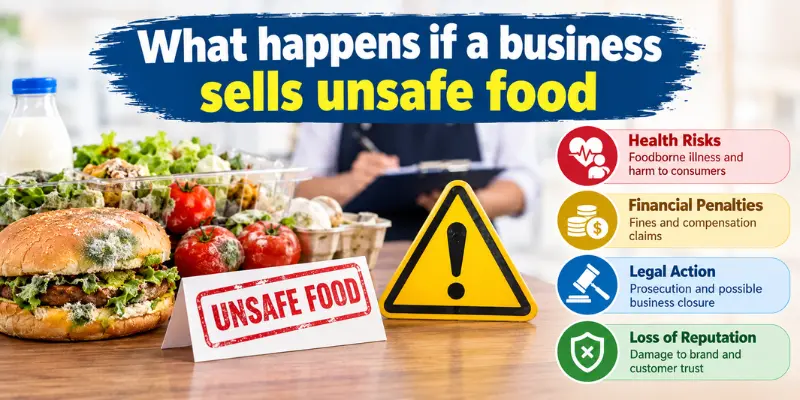
The consequences depend on the circumstances and the applicable provisions. Section 59 addresses punishment for unsafe food, with different levels of punishment linked to the harm caused. Other provisions may also be relevant depending on the facts.
Does the Act apply to restaurants and small food businesses?
The Act covers a broad range of food business activities, including food service and retail. However, the precise licensing or registration requirements depend on the applicable rules, business category, and any relevant exemptions or special provisions.
Has the Food Safety and Standards Act, 2006, been amended?
Yes. FSSAI lists amendments to the Act, including amendments in 2008, 2011, and 2023. Businesses should check the current official legislation and relevant notifications rather than relying only on the original Act.
Where can I read the full Food Safety and Standards Act, 2006?
You can read or download it from the official FSSAI Act page or consult the India Code document.
Conclusion
The Food Safety and Standards Act, 2006, provides a central legal framework for food safety in India. It establishes science-based standards, defines responsibilities for food business operators, and provides mechanisms for enforcement when food fails to meet applicable requirements.
For businesses, the most useful starting points are understanding the provisions relevant to their activities, maintaining suitable hygiene and traceability systems, checking product labels, and keeping up with applicable regulations and amendments. Particular attention should be paid to Sections 23, 26, 28, 31, and 48–59, while recognising that the relevance of each provision depends on the circumstances.
Ultimately, effective compliance requires more than reading the original Act. Businesses should consult the latest official legislation and regulations, maintain practical food safety controls, and obtain professional advice when a specific legal issue arises. These steps can help protect consumers, reduce avoidable compliance risks, and support responsible food business operations.
Please Write Your Comments