How the Right Cable Ties Improve Safety and Efficiency on Construction Sites
Updated: 24-Jul-2026
239
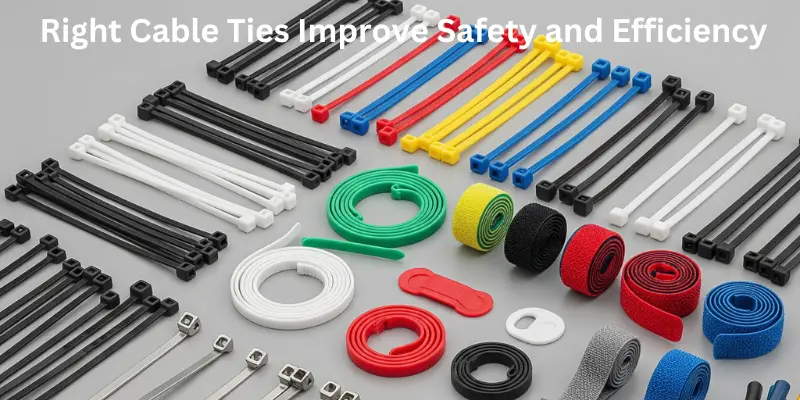
Walk through any active construction site and you will see kilometres of temporary power lines, data cables, conduit runs, and scaffolding netting. What holds much of it in place is one of the most underrated components in the industry: the humble cable tie. Specified correctly, cable ties speed up installation, reduce trip and snag hazards, and survive years of UV exposure, heat, and vibration. Specified poorly, they become brittle, snap under load, and create exactly the failures they were meant to prevent.
Because they are cheap and everywhere, cable ties rarely receive any engineering attention. Yet on a large commercial or infrastructure project, hundreds of thousands of them will be installed across electrical, mechanical, and civil packages — and each one is a small structural connection with a load rating, a service temperature, and a design life. This guide covers what civil engineers, electrical contractors, and site managers should know before ordering cable ties for a project, and how to avoid the most common (and most expensive) specification mistakes.
Why Cable Ties Matter More Than You Think
On paper, a cable tie is a minor consumable that appears nowhere in the bill of quantities except as a lump-sum sundry. In practice, it plays a role in several safety-critical and quality-critical areas of a project:
- Electrical safety — securing temporary site wiring and preventing cables from sagging into walkways, standing water, or moving plant.
- Structural organisation — bundling conduit and rebar spacers, fixing debris mesh and safety netting to scaffolding, and dressing formwork services.
- HVAC and MEP works — supporting ducting insulation, securing flexible ducts, and dressing cable trays and ladder racks in risers and plant rooms.
- Long-term serviceability — a neatly dressed cable tray is faster to inspect, test, and modify years after handover, which directly reduces the building owner’s maintenance costs.
A failed tie on a cable tray six metres above a plant room floor is not a trivial problem — it can drop a heavy cable bundle onto equipment or people, and replacing embrittled ties across an entire installation is slow, disruptive work at height. That is why material grade and load rating deserve the same attention as any other specified component on the project.
Nylon 66: The Industry Standard
Most quality cable ties are injection-moulded from Nylon 66 (polyamide 66), a material chosen for its balance of tensile strength, flexibility, abrasion resistance, and temperature tolerance — roughly −40 °C to +85 °C in continuous service. However, “nylon” is not a single specification. The grade of the compound determines whether a tie survives its environment or fails within a season:
| Grade | Typical Colour | Best For |
|---|---|---|
| Standard Nylon 66 | Natural / white | Indoor electrical rooms, plant rooms, general bundling |
| UV-stabilised Nylon 66 | Carbon black | Outdoor use — bridges, rooftops, solar farms, exposed cable trays |
| Heat-stabilised Nylon 66 | Black or natural | Near boilers, transformers, engine rooms, hot climates |
| Stainless steel (SS304/316) | Metallic | Tunnels, coastal structures, fire-rated and high-temperature installations |
The most common mistake on site is using standard natural-coloured ties outdoors. Without UV stabilisation, nylon embrittles within one to two seasons of direct sunlight, and ties begin failing in bulk — usually all at once, because they were all installed at the same time. For any exposed application, carbon-black UV-stabilised ties should be treated as the minimum acceptable specification, and for coastal, tunnel, or fire-rated work, stainless steel ties are worth the additional cost.
A second, less visible issue is recycled or blended resin. Low-cost ties made from regrind material can look identical to virgin Nylon 66 but deliver significantly lower and less consistent loop tensile strength. This is one of the strongest arguments for sourcing from a certified producer with batch-level traceability rather than buying unbranded stock through trading platforms.
Reading the Specifications That Actually Matter
When comparing suppliers and quotations, look past the price per bag and check the following four items:
- Loop tensile strength — stated in pounds or newtons (for example 18 lb, 50 lb, 120 lb / 80 N, 220 N, 530 N). Match this to the actual bundle weight with a sensible safety factor, especially for vertical runs and suspended trays where the tie carries sustained load.
- Material certification — reputable products are backed by certificates such as UL 62275 (the international cable tie standard), CE marking, and RoHS compliance, confirming flammability rating (typically UL94 V-2) and material composition. Ask for the actual certificates, not just logos on a datasheet.
- Operating temperature range — critical for plant rooms, rooftop installations, and projects in hot climates, where ambient plus solar gain can push tray temperatures well beyond 60 °C.
- Moisture conditioning — nylon is hygroscopic, and its flexibility depends on moisture content. Properly conditioned and packaged ties stay flexible instead of snapping during installation in dry or cold weather — a frequent complaint with cheap stock that has been warehoused badly.
For large projects, it also pays to source directly from an established cable ties manufacturer rather than through several layers of resellers. Direct sourcing gives you consistent resin quality between batches, access to test certificates and pull-test data, custom lengths and colours for circuit identification, and significantly better pricing at carton and pallet quantities — which matters when a single commercial project can consume hundreds of thousands of ties across its electrical and mechanical packages.
Sizing: Match the Tie to the Job, Not the Job to the Tie
Under-sized ties are a load risk; over-sized ties waste money and look unprofessional in dressed trays. A practical site stock covers most needs with a short range:
- 100 mm × 2.5 mm (18 lb) — light bundling of data and control cables.
- 200 mm × 4.8 mm (50 lb) — the general-purpose workhorse for power cables and conduit.
- 300–370 mm × 4.8–7.6 mm (50–120 lb) — large bundles, tray work, and ducting.
- Heavy-duty 9 mm-wide ties (175 lb+) — suspended loads, scaffolding netting, and hoarding fixings.
As a rule of thumb, the tie should wrap the bundle with at least 25 mm of spare tail after tensioning, and the rated loop strength should be at least twice the static load it will carry.
Practical Tips for Site Use
- Do not over-tension. Over-tightened ties bite into cable insulation and can deform conductors over time, particularly on soft-insulated LSZH cables. Use a tensioning tool with a calibrated cut-off on critical work.
- Cut flush. A tie tail cut at an angle leaves a razor-sharp edge at hand height in a cable tray — one of the most common causes of lacerations during later maintenance. Flush-cutting tools eliminate this entirely.
- Colour-code by system. Using different tie colours for power, data, fire alarm, and BMS cabling makes future fault-finding and alterations dramatically faster, at essentially zero extra cost.
- Store properly. Keep ties in their sealed bags, away from direct sunlight, until the day of use — this preserves moisture content and flexibility.
- Never reuse standard ties. The pawl-and-teeth mechanism is designed for a single locking cycle. If a bundle needs to be reworked, cut the tie off and fit a new one, or specify releasable ties for areas expected to change.
Choosing a Supply Partner for Large Projects
For contractors handling infrastructure, industrial, or high-rise projects, cable tie procurement is a volume game, and supply consistency matters as much as unit price. A mid-project switch between suppliers with different resin quality can leave half an installation ageing faster than the other half — invisible at handover, obvious five years later.
Established producers such as Shangbo Plastics manufacture nylon cable ties to international certification standards and supply in bulk directly to contractors, wholesalers, and distributors. Manufacturer-direct supply keeps per-unit costs low at pallet volumes, keeps quality traceable batch-to-batch across a multi-year project, and opens the door to custom options — printed ties for asset identification, specific colours for system coding, or non-standard lengths for unusual bundle sizes.
Whichever supplier you evaluate, ask for sample batches and physical test data before committing to a project-wide order. Five minutes of pull-testing on site — tension a sample tie around a bar and load it to failure with a spring scale — will tell you more about real-world quality than any brochure, and can save an expensive re-work later.
Conclusion
Cable ties will never appear on a project’s critical path, and no client will ever compliment the tie selection at handover. But they quietly affect safety, inspection speed, and long-term maintainability across every electrical and mechanical package on the job. Specify the right material grade for the environment, verify certifications rather than assuming them, buy at manufacturer-direct volumes, and train crews on correct tensioning and flush cutting. Do that, and this smallest of components will do its job invisibly for decades — exactly as it should.
Please Write Your Comments