5 Orthosilicic Acid Benefits Every Formulator Should Know
Updated: 22-Sep-2026
6
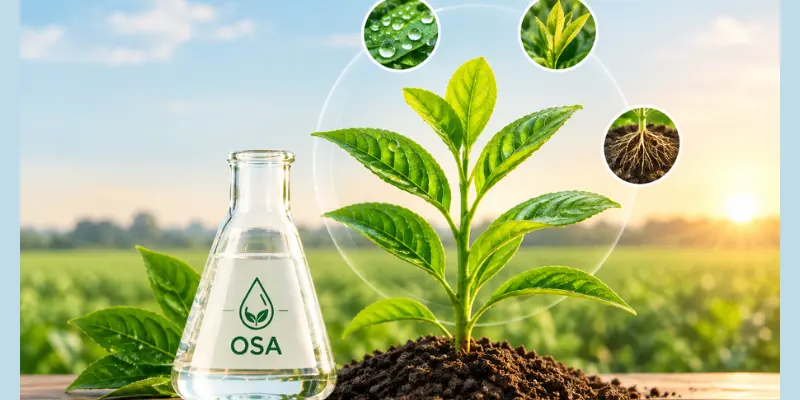
A formula that’s run clean for six months suddenly gets a complaint. Same resin blend, same OSA source listed on the batch card. Nothing on paper explains it.
Most formulators check the obvious things first, mixing speed, storage temperature, the usual suspects.
The orthosilicic acid itself rarely gets a second look, even though it’s often exactly where the problem started.
| Quick answer: The core orthosilicic acid benefits for formulators are five things: shelf stability, clean tank-mix compatibility, a higher share of truly bioavailable silicon, dosage that holds batch to batch, and one raw material that works across crops and delivery formats. Each is explained below. |
What Makes Orthosilicic Acid Different?
Silicon is everywhere in soil, but plants can barely use most of it. Silicates and raw silica sit there for years, weathering down before a root can actually absorb any of it.
Orthosilicic acid for plants skips that wait entirely. It’s already in the one form, monomeric Si(OH)4, that a plant can take up immediately.
Plant-nutrition literature widely recognizes it as the primary silicon form plants absorb directly, while silicates and amorphous silica still need microbial and chemical weathering first.
That’s the entire premium behind OSA as a raw material, a real chemistry difference, not a marketing claim.
5 Real Benefits Formulators Get From Orthosilicic Acid
Five things separate a formulation built on properly sourced OSA from one that just has OSA listed on the label.
Benefit 1: A Formulation That Actually Stays Stable
OSA doesn’t want to stay OSA. Left alone, it slowly polymerizes back into silica, the exact form a plant can’t use, and heat or time on a shelf speeds that up.
Patent literature on silicic acid stabilization shows complexing agents such as choline or carnitine salts can meaningfully slow this polymerization, in some documented cases holding stability for two years or more at room temperature.
The stabilization method matters more than the percentage printed on a spec sheet.
A properly stabilized orthosilicic acid 2% WSL formulation holds its usable silicon content through the shelf life claimed on the label. An unstabilized one can lose a real share of that before it’s even opened.
Benefit 2: Mixes Cleanly With Other Inputs
Tank-mixing OSA with the wrong partner causes real problems, not hypothetical ones. Alkaline pesticides and electrolyte-heavy fertilizers can destabilize a poorly buffered OSA solution mid-mix, long before it reaches a leaf.
A silicon fertilizer for formulators building a multi-input product needs to know this upfront, not discover it in a field trial.
University extension guidance recommends a small jar test before committing to a full batch, and it catches most of these issues in minutes.
Benefit 3: More of What You’re Paying For Actually Works
Two products can both say “2% silicon” and perform completely differently. What actually matters is how much of that number is bioavailable silicon for plants, not just silicon sitting in the bottle in some inert form.
That’s why a spec sheet needs two numbers, not one: total orthosilicic acid content, and plant-available silicon equivalent, listed separately. A formulation built on the first number alone can look fine on paper and still underperform for silicon-responsive crops.
Benefit 4: Dosage That Holds From Batch to Batch
A dosage recommendation is only as reliable as the batch it’s based on. If supplier quality control drifts between production runs, the same dosage that worked last quarter can suddenly under or overperform.
This is where an orthosilicic acid manufacturer with real QC discipline earns its keep, a Certificate of Analysis with every batch, and stabilization chemistry that holds steady run after run.
Benefit 5: One Formulation Across Many Crops
Rice, sugarcane, fruit trees, vegetables, a well-built OSA base doesn’t usually need a separate formulation for each.
The same orthosilicic acid for plants works across foliar sprays, drip systems, and tank-mix programs for most crop types, with mainly the schedule changing by crop, one reliable raw material instead of several narrow-use ones.
What to Check Before Trusting a New Supplier
A few checks before committing to a supplier save a lot of trouble later.
- Confirm both numbers on the spec sheet: total OSA and plant-available silicon, not just one.
- Ask how the product is stabilized, and whether that method is disclosed at all.
- Request a Certificate of Analysis for the specific batch being purchased, not a generic one.
- Check export and compliance documentation if the product is crossing borders.
An orthosilicic acid manufacturer willing to share all four without hesitation is usually one worth building a formulation around.
Conclusion: Find the OSA You Don’t Have to Double-Check
Most formulation problems traced back to OSA quality share the same root cause: nobody checked the stabilization method or batch consistency before committing to a supplier.
A manufacturer’s own technical data sheet is usually the fastest way to see whether both spec numbers and batch documentation are actually there.
Questions Formulators Actually Ask
What concentration range does OSA typically come in for formulation work?
Most commercial OSA sits around 2% by weight, though some suppliers offer higher concentrations for specific needs. Concentration matters less than whether the plant-available portion is verified separately.
Can OSA be formulated alongside micronutrients or other actives?
Usually, yes, but compatibility depends on pH and electrolyte load more than anything else. A silicon fertilizer for formulators building a multi-active product should jar-test any new combination before scaling it.
What does bioavailable actually mean in testing terms?
It means the silicon is already in the monomeric Si(OH)4 form a plant can absorb directly, verified through a plant-available silicon assay, not inferred from total silicon content alone.
Please Write Your Comments