Kylian Mbappé’s Evolution: From Explosive Winger to Complete Goalscorer
Updated: 15-Oct-2026
48
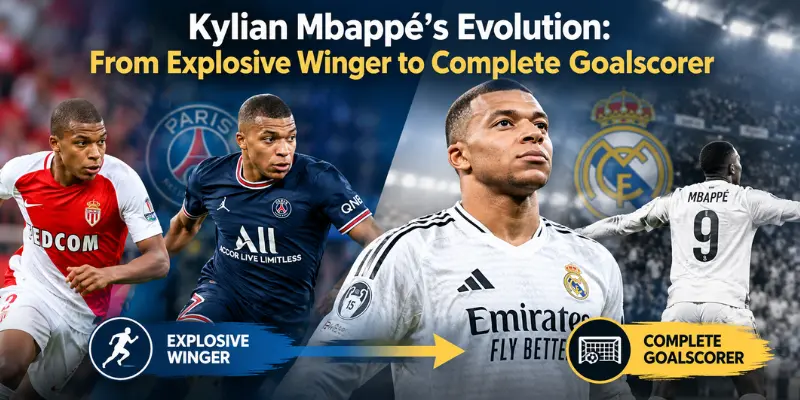
Kylian Mbappé first attracted attention as a forward who could turn open space into a scoring chance within seconds. His acceleration made defensive lines vulnerable whenever they moved away from their penalty area. That quality remains part of his game, but defining Mbappé only through speed now misses much of his development. He has gradually expanded his movement, finishing and positioning to become a forward who can score against different defensive structures.
The transformation matters because opponents have spent years adapting to him. Teams know that leaving space behind the defence creates danger, so many try to limit the situations in which he can accelerate over long distances. Like the shifting possibilities associated with money time casino, the conditions around an attack can change quickly, but Mbappé’s response is based on recognition rather than chance. His development has been about finding additional solutions when his most obvious weapon is restricted.
The Early Version Was Built Around Space
During the first stage of his senior career, Mbappé was most dangerous when opponents gave him room to run.
He could begin from a wide position, attack the gap between full-back and centre-back and receive the ball while already accelerating. Once he gained a step on a defender, recovery became difficult.
This approach was particularly effective during transitions.
When possession changed, Mbappé did not need several touches to become dangerous. A midfielder could play directly into space, allowing him to attack before the defensive structure recovered.
His early success demonstrated the value of pace, but it also created the first tactical challenge of his career: what happens when opponents refuse to provide that space?
Moving Inside Changed His Responsibilities
As Mbappé began operating more frequently in central areas, his game required different skills.
A winger can often receive while facing the defence. A central forward regularly receives with a defender behind him, less space around the ball and fewer opportunities to build speed before contact.
Mbappé therefore had to improve his movement before receiving.
Instead of waiting for the ball, he began using short changes of direction to separate from centre-backs. He could move toward midfield, draw a defender forward and then turn toward goal.
This development allowed him to remain involved against deeper defensive blocks.
It also changed his relationship with teammates. He was no longer simply the player expected to finish transitions. He increasingly became part of combinations around the penalty area.
His Finishing Became Less Dependent on One Situation
Mbappé’s growth as a scorer is closely connected to the variety of chances he can convert.
A pace-based forward may depend on one-on-one situations after running behind the defence. Mbappé still excels in those moments, but his scoring repertoire has expanded.
He can finish after cutting inside from the left, attack passes across the six-yard area, shoot after receiving centrally and convert penalties.
The important change is the reduction in preparation time.
Inside a crowded penalty area, a striker may have only one or two touches before a defender closes the shooting lane. Mbappé has become more comfortable finishing quickly rather than always creating an ideal shooting position.
That efficiency makes him harder to control through defensive positioning alone.
The Left Side Remains His Starting Platform
Despite his development as a central scorer, Mbappé continues to benefit from starting attacks on the left.
That position gives him access to two directions.
He can stay outside and accelerate beyond the full-back, or move inside onto his stronger foot. Defenders therefore have to protect both the touchline and the central route toward goal.
Starting wide also allows Mbappé to observe the defensive line before entering it.
Instead of spending the entire attack between centre-backs, he can approach the penalty area from a position where defenders must adjust their body orientation.
This is why describing him simply as a winger or striker has become increasingly difficult. His starting position and finishing position are often different.
Movement Without the Ball Creates More Goals
One of Mbappé’s most important developments has occurred when he does not have possession.
Elite scorers do not only react to passes. They influence where passes become possible.
Mbappé can move toward the ball to pull a defender away from the defensive line, then reverse direction once the defender follows. He can also delay a run until the passer has control, reducing the risk of being caught offside.
These movements require timing rather than maximum speed.
His pace remains useful, but the advantage often begins before he accelerates. If a defender takes one step in the wrong direction, Mbappé may need only a short burst to create separation.
That is a more economical use of his physical qualities.
Deeper Defences Forced Better Decision-Making
As Mbappé’s reputation grew, opponents became more cautious.
Defensive lines dropped deeper, full-backs received support, and teams attempted to prevent the isolated one-on-one situations he wanted.
This reduced the amount of open grass available but created another development opportunity.
Mbappé had to decide when to dribble, when to combine and when to move away from possession.
Against a compact block, attempting to beat multiple defenders on every attack becomes inefficient. Quick combinations can move defenders faster than individual dribbling.
His ability to participate in those combinations has made him less dependent on transitions.
International Football Expanded His Tactical Education
International football has also contributed to Mbappé’s development.
Tournament matches often require forwards to operate under different conditions within a short period. One opponent may defend deep, while another presses and leaves space behind.
Mbappé has experienced both scenarios at the highest level.
His performances for France have shown how his role can change depending on the opponent. In some matches, he becomes the main transition threat. In others, he must receive closer to the penalty area and create chances against an organized defence.
That variation has helped turn specialization into versatility.
The Next Stage Is About Efficiency
Mbappé’s evolution does not mean speed has become less important. It means he needs it less often.
A forward who can score through movement, positioning and rapid finishing does not have to win every attack through a long sprint.
That distinction may become more important as his career progresses.
Physical acceleration eventually declines for every player. The forwards who remain productive are usually those who learn to create advantages before the sprint begins.
Mbappé has already started that transition.
He emerged as a winger who punished space. He developed into a forward capable of creating scoring situations even when that space disappears. His pace still changes matches, but positioning, finishing and decision-making increasingly determine how often he reaches the decisive moment.
That is what has transformed Mbappé from an explosive runner into a more complete goalscorer.
Please Write Your Comments