Job-Site Risks Handyman Businesses Often Forget to Insure
Updated: 7-Sep-2026
64
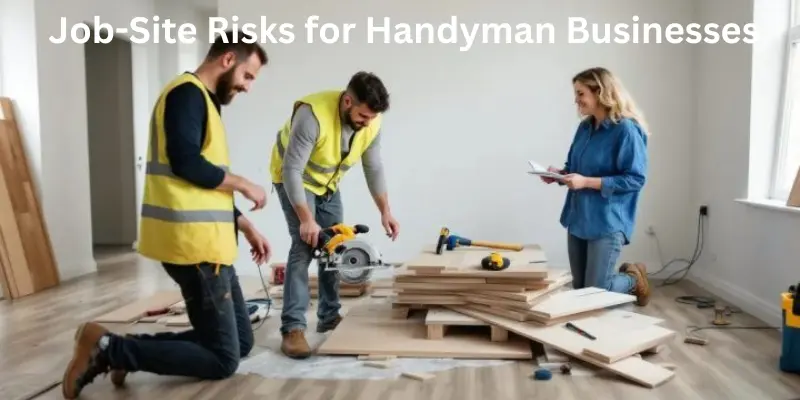
A handyman can arrive with the right ladder, eye protection, and tools and still leave a job facing a costly claim. Safety equipment helps prevent injuries. Insurance addresses certain financial consequences when an accident happens. Neither replaces the other, and buying a policy without checking what work it covers can leave an expensive gap.
For a small US handyman business, the practical starting point is a clear description of the jobs performed, the people doing them, and the equipment traveling between sites. That information matters more than choosing the lowest advertised premium.
A small repair can cause damage beyond the repair itself
Imagine installing shelves and accidentally damaging a concealed water pipe. The repair to the pipe may be only part of the problem: water can damage the customer’s flooring, furniture, or neighboring rooms. A misplaced tool can also create a trip hazard for someone passing through the work area.
General liability insurance commonly addresses certain third-party bodily injury and property damage claims, subject to the policy’s terms, limits, and exclusions. It should not be treated as a guarantee covering every mistake. The cost of redoing defective work can be treated differently from resulting damage to other property.
Before starting a job, photograph the work area, identify access restrictions, and agree on the scope in writing. Before buying insurance, ask a licensed agent how the policy would respond to accidental damage during work and to damage discovered after completion.
The work description may be narrower than the actual work
Handyman work can mean furniture assembly and minor painting for one business, but repairs involving ladders, plumbing fixtures, or exterior structures for another. An insurer’s accepted classification may not include every service a customer asks for.
A request that sounds simple, such as adding electrical work to a painting visit, may change the risk substantially. It can also raise licensing or permit questions that insurance does not resolve.
List every service offered, including occasional jobs, subcontracted work, and work at height. Ask which activities are excluded or require a different policy. Update the insurer when the service mix changes rather than assuming a general business description covers the expansion.
Tools do not necessarily share the vehicle’s coverage
A parked work van can contain much of a small business’s earning capacity. If tools are stolen, the immediate loss includes not only replacement equipment but also the ability to finish scheduled jobs.
Do not assume an auto policy insures the tools inside the vehicle. Tools and equipment coverage, sometimes arranged through an inland marine policy, can address certain movable business property risks. Coverage for theft from an unattended vehicle, equipment kept at home, borrowed tools, and rented machinery varies.
Maintain an inventory with serial numbers and photographs, retain purchase records, and use secure storage. Ask about replacement cost versus depreciated value, deductibles, per-item limits, and any locked-vehicle or overnight-storage conditions. These details can matter more than the policy’s headline limit.
A helper’s injury is a separate question
Bringing a helper can make lifting and access safer, but it introduces an employment-related risk that general liability should not be assumed to cover. Workers’ compensation requirements vary by state, business structure, and staffing circumstances.
Calling someone an independent contractor does not by itself settle their legal classification or determine who is responsible after an injury. A business owner also should not assume personal injuries are covered by a policy designed for employees.
Before adding help, review worker classification and coverage requirements with qualified professionals. Set clear expectations for training, protective equipment, ladder use, and reporting injuries. Obtain and review subcontractors’ insurance documentation where appropriate, rather than relying on a verbal assurance.
Driving between customers creates its own exposure
A vehicle used to transport tools and visit job sites is part of the business operation. Whether a personal auto policy permits that use depends on the policy and the circumstances. Business owners should describe their actual driving activities to the insurer instead of assuming that occasional work trips are automatically covered.
Ask about commercial auto coverage when appropriate, and discuss situations involving rented vehicles or employees using their own cars for business. Keep vehicle maintenance and safe loading on the same checklist as ladder inspections and protective equipment.
A certificate is not a substitute for checking the policy
Property managers and customers may request a certificate of insurance before allowing work to begin. The certificate is evidence of coverage information at a point in time; it does not replace the policy or automatically change its terms.
Contract requirements can involve additional-insured status, particular limits, or coverage for completed operations. Those requests may require policy endorsements. Clarify the requirements before signing a contract, and have the insurer or agent confirm what can actually be provided.
Compare coverage against a realistic workweek
When reviewing insurance options for handyman businesses, use a realistic workweek as the comparison: the repairs performed, heights reached, customers visited, vehicles driven, tools carried, and people involved. A policy that fits a solo furniture assembler may not fit a growing repair crew.
Compare covered activities, exclusions, deductibles, limits, and certificate or endorsement support alongside price. Keep written answers to important coverage questions. Revisit the policy when you add staff, buy equipment, accept larger contracts, or begin offering a different service.
Good risk management starts before the first tool leaves the van. Clear job scopes, safe work practices, documented equipment, and coverage matched to the business provide a more useful foundation than relying on either safety gear or an insurance certificate alone.
This article provides general educational information, not insurance or legal advice. Coverage depends on the policy and circumstances. Confirm current requirements and suitable coverage with a licensed insurance professional and the relevant state authorities.
Please Write Your Comments