What Breaks When a Toolbox Talk Only Exists as One Flattened File
Updated: 15-Sep-2026
94

Fourteen people on a morning shift, a tablet propped against a gang box, and a four-minute induction clip that nobody in the back row can follow. The narration is there. It is simply sitting underneath a music bed that the production company added, and the little speaker treats that music as the main event. On a floor running somewhere near eighty-five decibels, the part carrying the lockout sequence loses to a synth pad.
Nobody signs off on that briefing honestly. They sign off because the sheet is in front of them. My team stopped calling this a training problem about a year ago and started calling it a file problem, which is how we ended up with one browser tab permanently parked on a vocal remover that will strip the voice out of a finished recording and, more usefully for us, do the reverse.
The audio arrives flattened and nobody on a safety team owns it
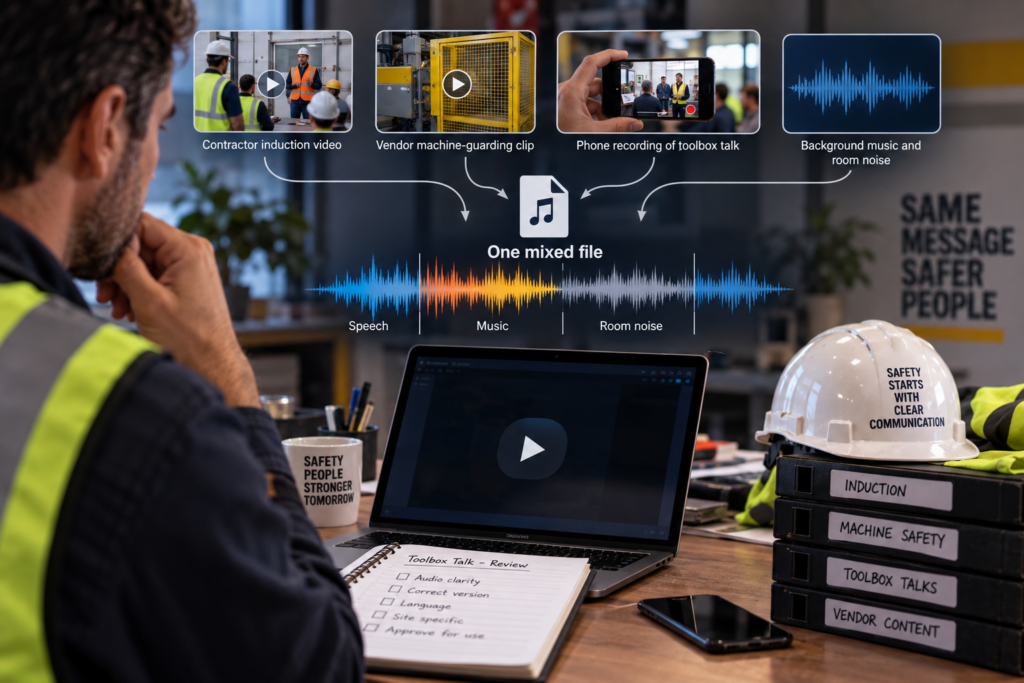
Safety departments inherit media. A contractor hands over an induction video. A vendor supplies a machine-guarding clip. Somebody’s phone holds the only recording of the talk that actually went well. All of it arrives as a single mixed file, already committed, with speech and music and room noise welded together.
That welding is the root of it. You cannot turn down one element of a mix, because what lands on your desk is no longer several elements.
Four ways it goes wrong on site
Music wins the room. Fine in an office, useless in a plant. The mix was balanced for headphones and gets played through a speaker competing with compressed air.
Language wrong, visuals right. A crew needs the briefing in Spanish. Footage, captions, on-screen callouts are all correct. Only the English narration has to go, and re-licensing the production to get a clean bed back is a six-week conversation.
The wrong revision plays. Two files, both called something like induction_final, one of them describing a guard that was replaced in March. This is the quiet killer, and strictly speaking no amount of processing touches it.
Nothing usable was captured in the first place. Somebody held a phone up in a loud room. A vocal remover cannot rescue a briefing that was never captured, and neither can anything else.
Where a vocal remover helps, and where the split takes over
Worth being precise here, because the useful version of this has a name: source separation. Feeding a mixed file into a tool that will split a mixed recording into four separate tracks hands back four files: one with the voice alone, one with drums, one with bass, one holding whatever else was playing. Every one of them begins at the same instant, which keeps them in register when you drop them into an editor. MP3 and WAV both upload, as do M4A and OGG, to a ceiling of fifty megabytes. Without an account you get five minutes of audio per job; signing in doubles the ceiling to ten, which covers most inductions and nearly every toolbox talk.
An honest limit is printed on the page itself: this reconstructs parts out of a finished mix rather than opening the original session, so ambience and overlapping sounds can surface in more than one output. For our purposes that is fine. Nobody here is remastering anything. We want the speech loud enough to survive a shop floor, or we want the bed without the speech so a translator can record over it.
When the goal is only the instrumental side of a file, the plain vocal remover route is shorter than a four-way split and arrives at the same place faster. The four-way split and the vocal remover both run in a browser without an account, and both write MP3 on the way out — a dull detail right up until the playback device is a five-year-old tablet that refuses half of what you hand it.
The failure that is not really about sound
Wrong-revision playback is the one that would cost us in an incident review, and for a long time we fought it with filenames. Filenames do not travel. Copy a file to a phone and the media player shows whatever sits in the tags inside that file, which across most of our library was blank or read Track 01.
So the second habit was to correct the details stored inside an MP3 before it goes anywhere. That editor reads the file on the device and writes a tagged copy without re-encoding the audio, so the recording itself is untouched and nothing leaves the laptop. That last part ended an internal argument fast, because our recordings have people’s names in them. Ten files can be loaded at once, a hundred megabytes each, three hundred total, and the fields a player will display are all editable: title, artist, album, year, track number, genre, comment.
We fill them flatly. Title carries topic and revision date. Album carries the site. Comment carries the standard it maps to. One caution, learned the hard way and also printed on the page: Reset restores the tags that were loaded, so it will throw away edits you have not downloaded yet.
The rule we wrote down
No audio gets played to a crew unless two things are true. Speech has to stand on its own — bed pulled down, or pulled out with a vocal remover — tested on the actual speaker in the actual room rather than on somebody’s headphones. And the file has to say what it is from the inside, so the version that plays is the version somebody approved.
Neither step is training. Both are file handling, which is precisely why they kept falling through the gaps. Ten minutes with a vocal remover and a tag editor costs less than one crew that heard a synth pad where the isolation sequence should have been, and far less than explaining to an investigator why the briefing on record does not match the guard that was actually installed.
Please Write Your Comments