The Most Overlooked Safety Risks on a Packaging Line
Updated: 30-Aug-2026
55
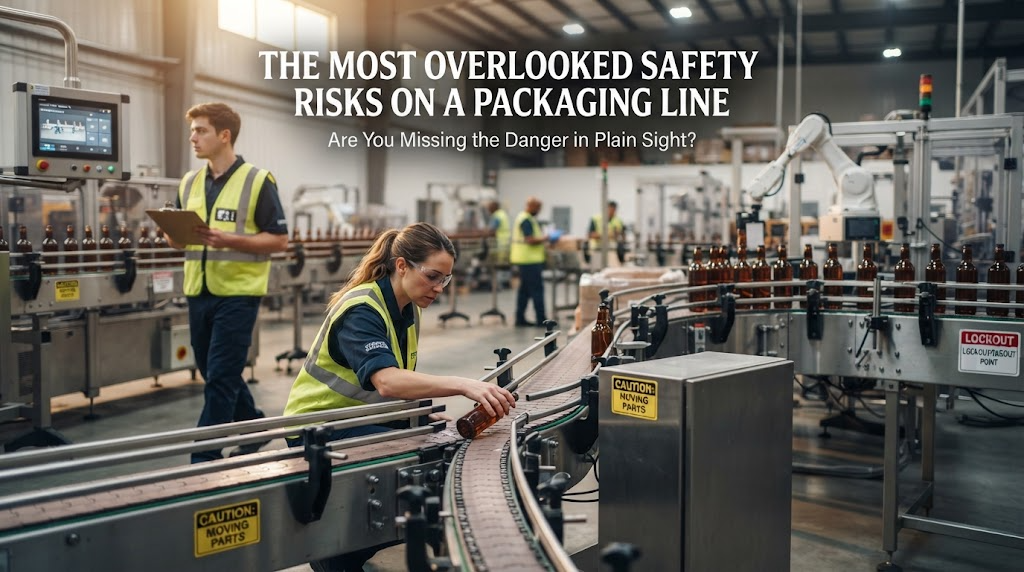
A packaging line can look deceptively simple from a distance. Products arrive, someone packs them, machinery seals or wraps them, cartons move towards dispatch and the cycle begins again.
Yet the most serious problems rarely come from the part of the process that looks dramatic. They often develop around ordinary actions repeated hundreds of times a day: reaching past a guard, clearing a jam without proper isolation, working too close to a heated surface, twisting to pick up cartons or stepping into a busy aisle because materials have been left where they should not be.
That is what makes packaging-line safety challenging. Familiarity can make risk almost invisible.
The goal is not to slow a workplace down with unnecessary procedures. It is to build a process where people can maintain a steady production rhythm without relying on shortcuts to keep up.
Familiar Machinery Can Become the Easiest to Underestimate
People tend to be especially cautious around unfamiliar equipment. Once they have operated the same machine for months or years, that caution can fade.
The machine has worked hundreds of times before. The operator knows its sounds, its controls and its usual quirks. Eventually, a guard may start to feel like an inconvenience rather than a safety control.
That is precisely where complacency becomes dangerous.
Packaging machinery can include moving belts, cutters, rollers, sealing mechanisms, heated components and automated sections capable of restarting quickly. A piece of equipment does not become less hazardous simply because an experienced employee has used it thousands of times.
Guarding, interlocks and other protective systems should therefore be treated as part of the machine, not optional features to work around when production becomes busy.
The same principle applies when choosing and operating equipment such as a shrink wrapper, sealing machine, conveyor or automated packing system. The important question is not only how quickly the equipment processes products, but how employees interact with it during loading, normal operation, cleaning, adjustment and fault clearing.
Safety problems often appear in those moments between normal production cycles.
The Jam Is Often More Dangerous Than the Job
A machine running normally is usually predictable.
A jammed machine is not.
Something may be caught between components, material may have folded incorrectly or a product may have moved out of position. Production stops, orders begin backing up and there is an understandable temptation to solve the problem as quickly as possible.
This is where a small production interruption can become a serious safety issue.
Reaching into machinery because “it will only take a second” is particularly risky when equipment contains stored energy or could restart unexpectedly. Switching a machine off using its normal operating controls may not always mean every source of energy has been safely isolated.
Electrical, mechanical, pneumatic, hydraulic, thermal or stored energy may still be present depending on the equipment.
Workplaces therefore need clear procedures for situations in which machinery must be cleaned, maintained, repaired, adjusted or unjammed.
The procedure should not exist only in a folder somewhere.
Operators need to know what constitutes normal adjustment, when equipment must be isolated, who is authorised to perform particular work and how they can confirm that a machine is actually safe before entering a hazardous area.
If workers have to improvise whenever something goes wrong, the safety system has already failed.
Heat Does Not Have to Look Dangerous
Not every packaging-line hazard moves.
Some sealing and wrapping processes use heated surfaces, wires, tunnels or other components that can remain hot even when the equipment is not visibly doing anything.
This creates an unusual risk because workers naturally associate danger with movement. A stationary part may appear harmless even when it is still hot enough to cause injury.
Heat should be considered when designing routine tasks around machinery, not just during emergency situations.
Where do operators place their hands when positioning products? Can someone accidentally lean against a heated section while reaching for something else? Where do employees stand while removing completed packages? Does a machine retain heat during cleaning or maintenance?
Clear operating instructions and appropriate guarding can help, but workplace layout also matters.
A narrow work area can force people closer to equipment than necessary. Poorly positioned shelves can encourage workers to reach across a hot section. Materials stored beside machinery can make an otherwise simple movement awkward.
Good safety design considers the person, the machine and the space around them together.
Repetitive Work Is Still Physical Work
Packaging often involves small movements rather than obvious heavy labour.
A worker may pick up a product, turn, place it into packaging, move it to the next stage and repeat the sequence for several hours.
None of those movements appears particularly demanding on its own.
Repetition changes the equation.
Reaching too far, twisting the torso, standing in one position, lifting cartons from floor level or repeatedly handling products at an awkward height can gradually create strain.
This is why ergonomics should be considered part of packaging-line safety rather than treated as an unrelated office-health issue.
Sometimes the solution is surprisingly simple.
Frequently used materials can be positioned closer to the operator. Work surfaces can be adjusted to reduce excessive reaching. Heavy cartons can be stored at more manageable heights. Jobs can be organised so workers are not repeating exactly the same physical movement throughout an entire shift.
Automation can also reduce some repetitive handling, but only if the new process is designed properly. Introducing machinery while leaving employees constantly bending, reaching or carrying loads between poorly positioned stations simply moves the ergonomic problem somewhere else.
Housekeeping Is a Safety Control, Not a Cosmetic Exercise
Packaging operations produce things.
They also produce offcuts, empty cartons, film, strapping, labels, pallets and discarded materials.
If those items are not managed continuously, a clean packing area can become cluttered remarkably quickly.
A strip of packaging material across a walkway might look insignificant until someone carrying a carton cannot see it. An empty pallet placed temporarily beside a workstation can narrow a pedestrian route. Loose film on the floor can create a slipping or tripping hazard.
The phrase “we’ll move it later” deserves particular attention in busy workplaces.
Later often means after the rush, after the shift or after someone has already had to navigate around the obstruction multiple times.
Good housekeeping works best when disposal and storage are built into the workflow. Staff should not have to walk across the work area to discard every small offcut, and finished goods should have an obvious location rather than gradually spreading into pedestrian areas.
A tidy floor is not about appearances. It makes unusual conditions easier to spot.
Production Targets Can Quietly Rewrite the Rules
Most unsafe shortcuts do not begin with someone deciding that safety does not matter.
They begin with pressure.
A large order needs to leave today. A machine stopped unexpectedly. Someone called in sick. The warehouse is running behind. A customer has changed a deadline.
Under those conditions, a procedure that normally feels reasonable can suddenly feel too slow.
That is why safety culture is tested most clearly when production becomes difficult.
If employees believe they will be criticised for stopping a machine, reporting a fault or taking time to isolate equipment correctly, they may start making their own compromises.
The most effective response is not another poster telling people to “be safe”.
Supervisors need to make it clear, through actual decisions, that production targets do not override essential controls. If a jam takes longer to clear safely, that delay has to be treated as part of operating the equipment rather than an employee failure.
Otherwise, workers receive two conflicting instructions: follow the procedure and never let production stop.
Eventually one of them will win.
New Employees See Risks That Experienced Workers Stop Seeing
Experienced operators bring valuable knowledge to a packaging line, but experience has an interesting side effect.
People adapt to their environment.
A machine that makes an unusual noise every afternoon can eventually become “the machine that always does that”. A loose fitting may become normal because everyone has learned to work around it. A badly positioned cable may stop being noticeable.
A new employee has not yet developed those blind spots.
That makes induction a two-way opportunity.
New staff certainly need training on operating procedures, emergency controls, restricted areas and reporting systems. But supervisors should also pay attention when newcomers ask why something is done in a particular way.
Occasionally, the answer will be perfectly reasonable.
Sometimes the only answer is, “That’s how we’ve always done it.”
Those moments are worth investigating.
Maintenance Safety Begins Before Something Breaks
There is a tendency to think about maintenance when equipment fails.
By then, pressure is already building.
Planned inspection and maintenance make it easier to identify deteriorating guards, worn components, damaged controls, unreliable sensors and other problems before employees have to deal with them during a production interruption.
It also creates an opportunity to review the process around the equipment.
Are emergency controls accessible? Have modifications changed how the machine is used? Are guards and interlocks functioning as intended? Can cleaning be performed without unnecessary exposure to hazards?
After maintenance, machinery should not simply be returned to production without checking that protective systems, guards and relevant components are back in place.
The small details matter because maintenance frequently changes the state of a machine.
Something has been opened, removed, adjusted or replaced. A deliberate restart process helps ensure the equipment returns to normal operation safely.
PPE Should Not Be Asked to Solve a Machine-Design Problem
Personal protective equipment has an important place in many workplaces, but it is easy to give PPE jobs it was never designed to do.
Gloves, footwear, eye protection or hearing protection may be appropriate for particular packaging tasks depending on the hazards involved.
They should not become the main answer to a hazard that could have been eliminated, isolated or controlled through better machinery design or guarding.
If workers can regularly reach a dangerous moving part, the first question should not automatically be which glove they should wear.
Likewise, if people continually have to stand beside an unprotected hot surface, better PPE may be useful, but it does not remove the underlying exposure.
A stronger safety approach looks at the source of the risk first and considers how worker behaviour and PPE fit around the remaining hazard.
The Best Packaging Line Is Predictable
Speed gets most of the attention in packaging operations, but predictability may be the more valuable characteristic.
A good line has a clear flow.
Workers know where products arrive, where materials belong, how machinery is operated and what happens when something goes wrong. Pedestrians are not unexpectedly crossing equipment routes. Waste does not gradually take over the floor. Guards remain in place. Faults are reported rather than quietly tolerated.
Most importantly, stopping to deal with an abnormal condition is treated as normal work.
That may sound less exciting than introducing faster machinery or increasing output, but predictable systems are easier to manage safely and usually easier to operate consistently.
Packaging-line safety is rarely about one dramatic hazard.
It is the result of dozens of ordinary decisions made every day: where someone reaches, whether a guard stays closed, what happens when material jams, where an empty pallet is left and whether an employee feels able to stop production when something does not look right.
Those small decisions determine whether safety exists only in written procedures or actually survives contact with a busy working day.
Please Write Your Comments